Ultrasonic injector cleaning pulls deposits - carbon, varnish, coking - out of injectors that have been taken off the engine and dropped into a ~40 kHz bath. It runs about the equivalent of €25-70 per injector and only earns its keep as the first step of a full service that ends on a flow bench. What it will not do is undo mechanical wear: a worn nozzle, valve or needle cannot be washed back to spec.
“Ultrasonic clean and your injectors are as good as new” is an easy thing for a workshop to say. Some drivers really do get a smooth idle and no smoke back. Others pay the bill and drive off with the exact same fault. The thing that separates them is never the price of the job. It is what was actually wrong inside the injector: a deposit, or worn metal. Those two need completely different answers, and one of them no bath can give.
How much does ultrasonic injector cleaning cost?
Ultrasonic cleaning on its own runs about the equivalent of €25-70 per injector. Add a flow-bench test at €10-25 per injector, more or less depending on the injector type, then labour for removal and refitting on top (from around €25 per injector). Watch out for blended “average price” numbers. They lump chemical cleaning in with ultrasonic, and diesel in with petrol, so a single headline figure tells you very little. The table runs the options from cheapest to dearest.
| Method | Typical cost | What it actually does | When it makes sense |
|---|---|---|---|
| PEA fuel additive (DIY, in-tank) | ~€8-20 / bottle | Reduces and prevents deposits on injector tips; preventive | Light fouling, prevention between services |
| On-car chemical cleaning (no removal) | ~€25-50 / set | Dissolves deposits without pulling injectors; no dose measurement | Early symptoms, limited budget |
| Ultrasonic + flow-bench test (injectors removed) | ~€25-70/inj. + test €10-25/inj. | Lifts stubborn carbon/varnish from micro-gaps and measures dose and spray | Clear symptoms; screening before regeneration |
| Regeneration (replace worn parts + calibration) | ~€60-190/inj. (piezo €140-350); set €280-1200 | Replaces nozzle/valve/seals, recodes ISA-IMA | Confirmed mechanical wear |
| New injector | Solenoid ~€165-280/inj.; piezo ~€235-470/inj. (some Denso far higher) | Brand-new part | Regeneration uneconomic or impossible |
Costs are indicative, converted from 2026 Polish workshop price lists (many quoted net of VAT). The real figure depends on injector brand (Bosch, Delphi, Denso, Siemens/Continental) and the car.
How does ultrasonic cleaning work?
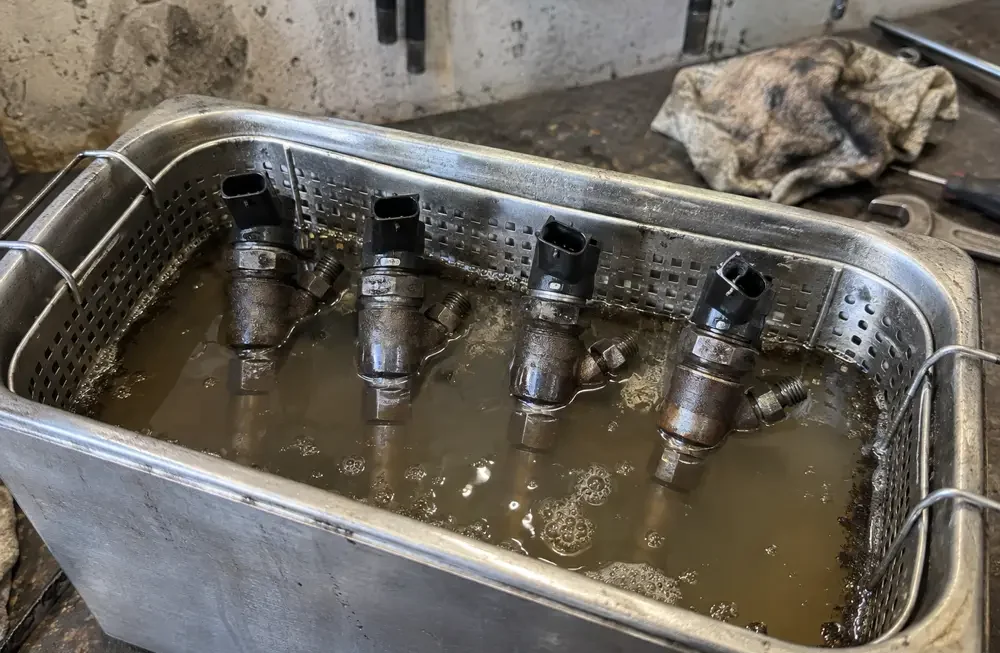
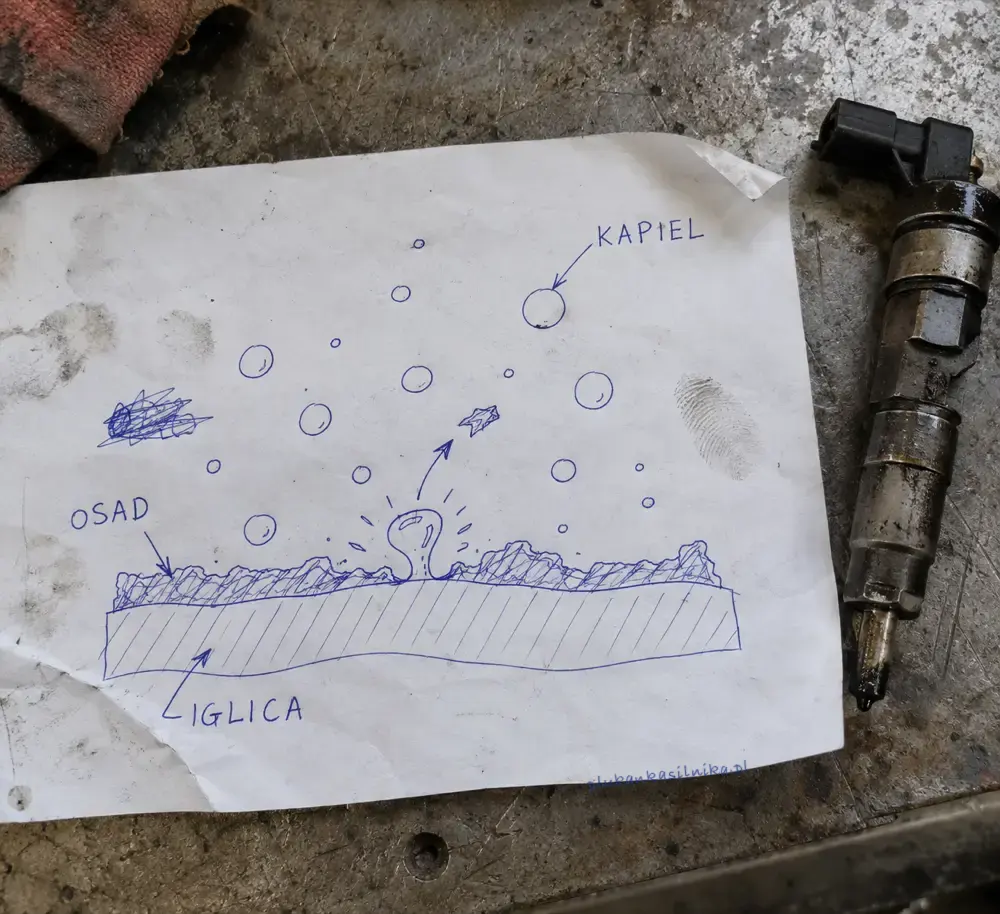
The mechanism is cavitation. The injector comes out of the engine, often partly stripped down, and goes into a bath of a dedicated non-corrosive fluid. Transducers fire ultrasonic waves through it and throw off millions of tiny bubbles. Each one collapses against the metal, and that little implosion knocks deposits out of micro-gaps that no in-tank additive will ever reach.
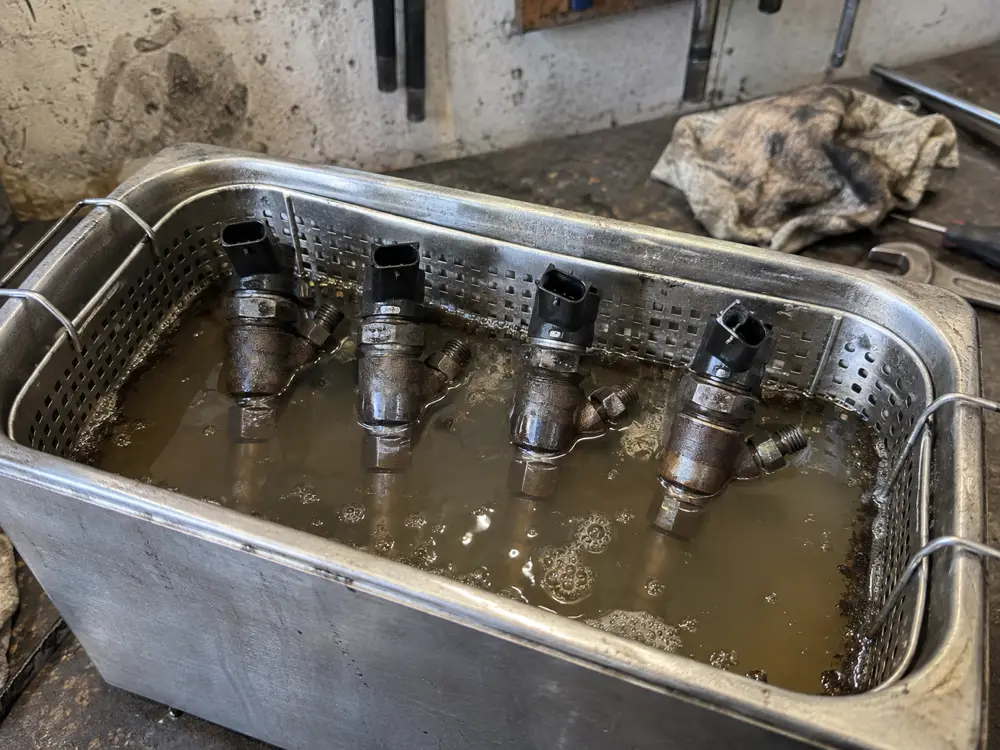
Typical process parameters:
- Frequency: around 40 kHz. That is the automotive standard, with the usable range sitting at 25-40 kHz.
- Bath temperature: 50-60 °C, warm enough for the chemistry to lift deposits, not hot enough to hurt the parts.
- Time: 15-30 minutes a cycle.
- Fluid: a purpose-made injector detergent, biodegradable and non-corrosive. Never abrasives.
Done right, it strips coking off the nozzle tip, varnish off the needle and valve, and the carbon that plugs the spray holes. The spray goes back to an even pattern and the dose evens out. All of that holds on one condition: the problem was a deposit in the first place.
Why cleaning alone is not enough - the flow bench
Ultrasonic cleaning is step one, not the whole job. A cleaned injector can still meter the wrong dose or leak past its internals, and none of that shows up when you look at it by eye. The only thing that settles it is a flow-bench test (Bosch EPS 708/815, Hartridge, Carbon Zapp and the like), which measures:
- electrical parameters of the solenoid/actuator,
- spray pattern and nozzle tightness,
- fuel dose at several operating points (idle, pilot, full load),
- back-leak (return flow) - how much fuel each injector sends back to the return line.
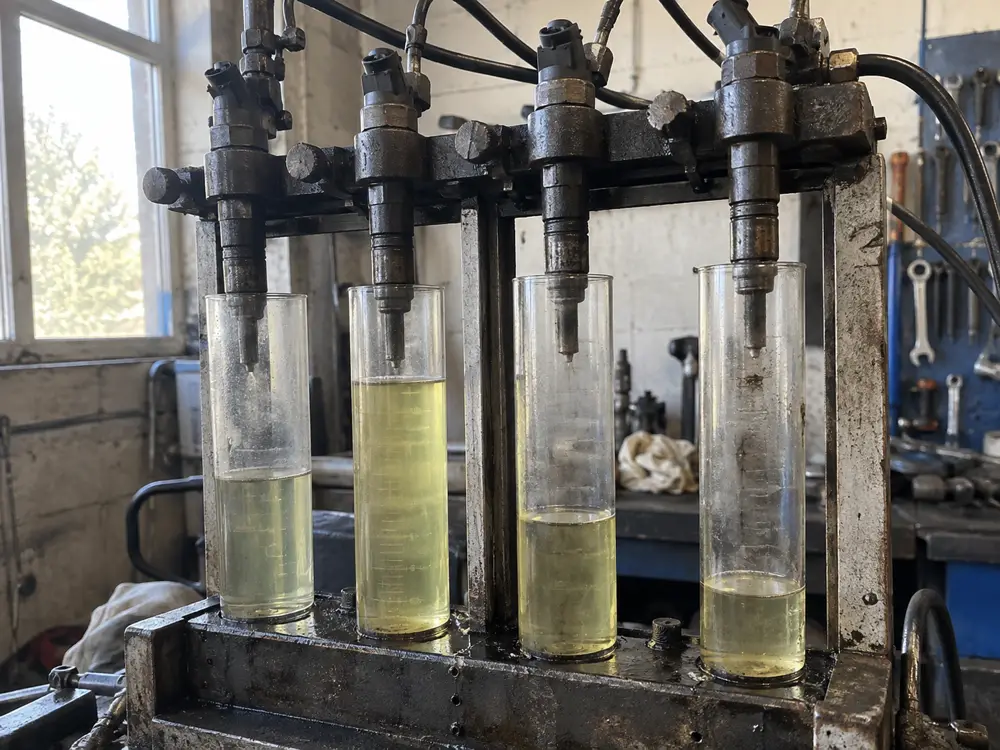
The back-leak test earns its place because a lot of mechanical faults never throw an ECU code. A healthy injector sends back very little fuel. One cylinder returning far more than the rest points straight at a worn valve seat or needle. Clean without measuring and you are working blind. For the warning signs, see our guide to symptoms of bad or clogged diesel injectors.
When cleaning will NOT help: deposits vs wear
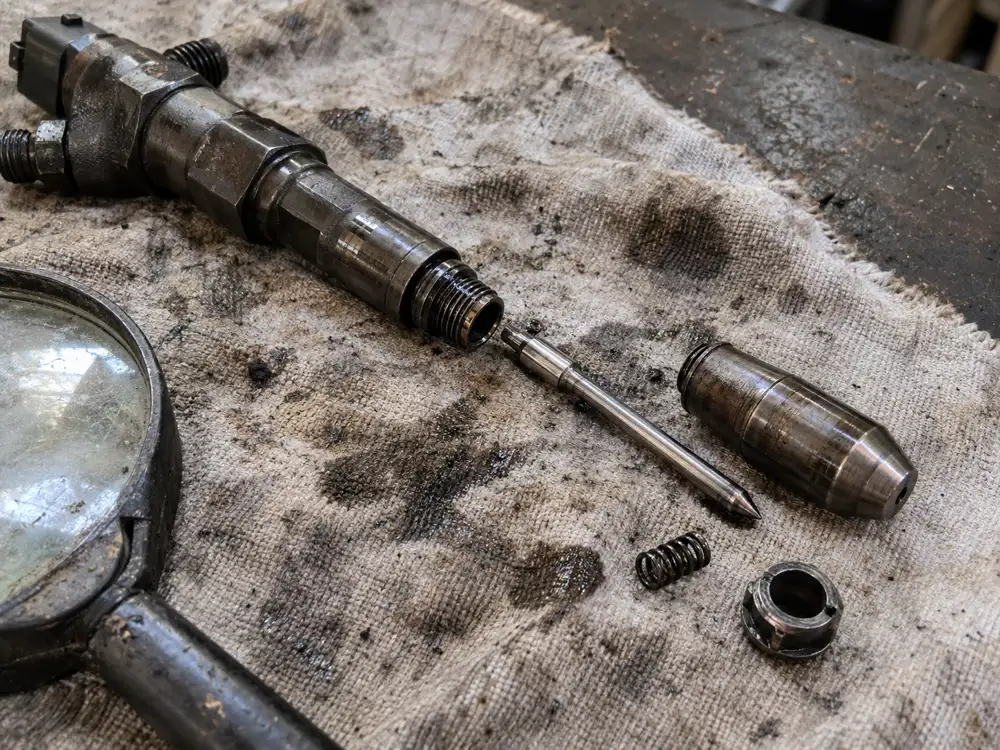
This is the distinction the whole job turns on. Deposits come off. Worn metal does not. A modern common-rail injector works at over 1600 bar, the nozzle hole measures under 160 µm and the clearance between needle and body sits under 10 µm. At that scale even light wear shifts the dose, and no bath on earth puts it back.
| Injector problem | Will ultrasonic cleaning help? | What is actually needed |
|---|---|---|
| Carbon / coking on the nozzle tip | ✔ Yes - it is a deposit | Clean + test |
| Varnish on needle and valve | ✔ Yes - it is a deposit | Clean + test |
| Internal deposits (IDID) from oxidised fuel | ✔ Partly - if it is deposit, not wear | Clean + test; prevent with additive |
| Worn nozzle / eroded needle seat | ✘ No - mechanical wear | Regeneration (new nozzle) |
| Worn valve seat, excessive back-leak | ✘ No | Regeneration (new valve) + calibration |
| Electrical coil failure / cracked piezo stack | ✘ No | Regeneration with parts, or replacement |
The people who regenerate injectors for a living say it without dressing it up: for a mechanical fault, “not even the best common-rail injector cleaner will help.” The nozzle is usually the first part they replace, not the part they wash back to spec. That is the tell of an honest workshop. It cleans and tests first, then tells you whether cleaning was enough or you are into regeneration.
Can you ultrasonically clean piezo injectors?
With care, and never the whole thing. Solenoid (electromagnetic) injectors take the bath happily. Piezo units (Bosch, Siemens/Continental) come with an iron rule: only the hydraulic parts go in, and only after the injector is stripped down. The connector, the coil, the actuator as a unit, those stay out. Leave them soaking in fluid and ultrasound and you invite corrosion and premature wear on parts machined to microns. A piezo stack that has cracked or delaminated is finished. At that point you are buying a new injector, not cleaning one.
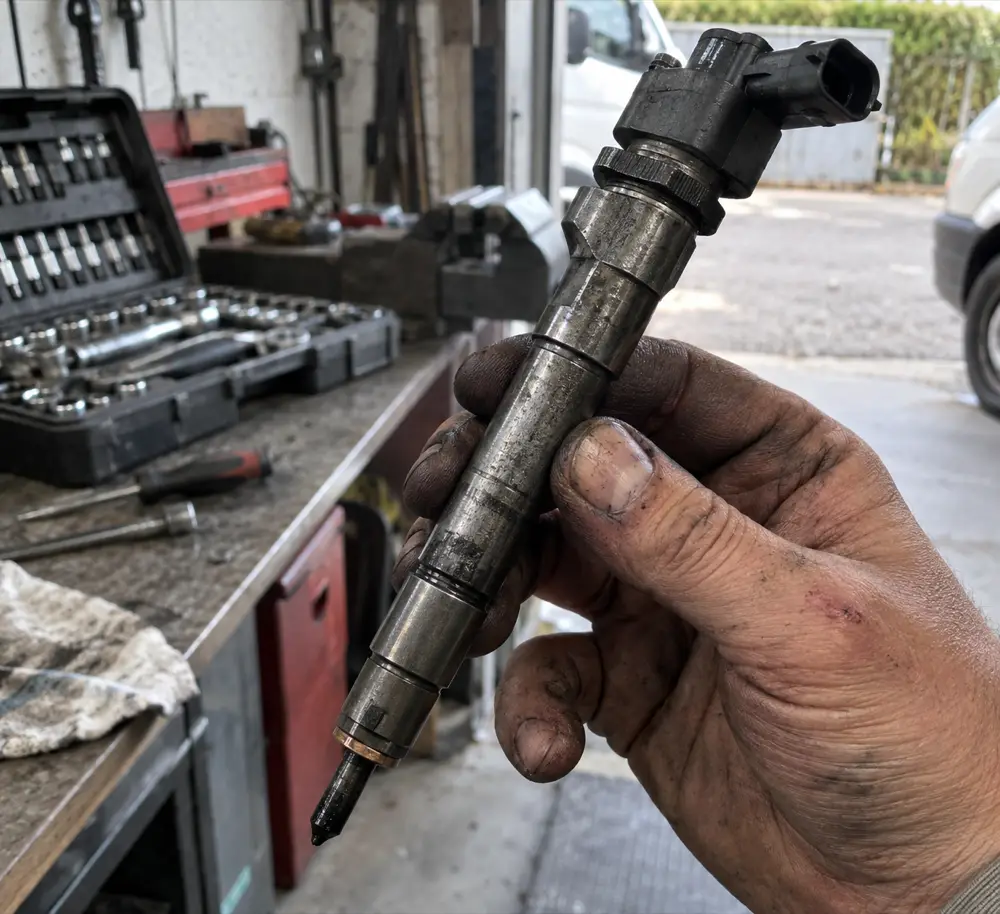
Anyone telling you “ultrasound damages nothing” is selling something, and it goes against how the trade actually handles these. Piezo work costs more, too. A BMW stack revitalisation, for instance, sits around €110/injector. So with piezo it pays twice over to pick a workshop that genuinely knows piezo and has a flow bench for the electrical side.
Ultrasonic, fuel additive or regeneration - which to choose?
It depends on how far gone the problem is:
- Fuel additive (PEA): for prevention and light deposits. Polyetheramine (PEA) detergents really do reduce and remove injector deposits. The standard CEC F-98-08 (DW10B) engine test shows the effect is repeatable and dose-dependent, with additised fuel restoring flow above the clean-injector baseline. This is the opposite of the old “fuel cleans your injectors” myth. Regulations force fuels to age, and the FAME (biodiesel) component oxidises and feeds deposits, something bodies such as PIMOT keep an eye on. An additive works on deposits, not on wear.
- Ultrasonic cleaning + test: when the symptoms are clear but the injector is not worn out yet. It doubles as a screening step, because the bench tells you whether cleaning was enough or you have to go further.
- Regeneration: when the bench shows wear. New nozzle (from ~€35/inj.), valve (from ~€60/inj.), seals, then calibration and ISA-IMA coding (~€15-30/inj.).
For how the deposits form in the first place, see our analysis of internal diesel injector deposits (IDID) in a B7 diesel and the full guide to diesel injector cleaning.
When does regeneration pay, and when a new injector?
It comes down to simple arithmetic. On solenoid injectors, regeneration (~€60-190/inj.) usually lands well under half the cost of new (~€165-280/inj.), so it pays. On piezo the two are often close: regeneration at €140-350/inj. against a new part at €235-470/inj., and there paying a bit more for a new injector with a warranty can be the smarter move. Either way, decide after the bench test. That is the only moment you actually know how many parts need replacing.
Don’t forget the hidden costs. Removal and refitting start around ~€25/inj. and climb for seized injectors that need a hydraulic puller, and you usually end up doing the whole set anyway. On decent fuel with regular filter changes, common-rail injectors go roughly 150,000-200,000 km. What kills them fastest is bad fuel, and water in the diesel most of all.
Frequently asked questions
How much is ultrasonic injector cleaning per injector and per set?
Roughly the equivalent of €25-70 per injector - about €100-280 for a set of four - plus a flow-bench test (€10-25/inj.) and removal/refitting (from €25/inj.). Workshop prices are often net of VAT, so add it on.
What is the difference between ultrasonic cleaning and regeneration?
Cleaning removes deposits. Regeneration replaces worn parts (nozzle, valve, seals) with calibration and coding. Ultrasound is usually the first step - on its own it is rarely enough for a worn common-rail injector.
Should I clean the injectors ultrasonically or go straight to regeneration?
Start with clean-and-test - it is the cheapest way to find out whether the fault is only a deposit. If the bench shows wear, you move to regeneration. Guessing without a flow bench is a shot in the dark.
When will cleaning injectors not help?
When the cause is mechanical wear (worn nozzle, needle seat, valve, excessive back-leak) or an electrical fault. Deposits come off; worn metal does not - then regeneration or replacement is the only fix.
Can piezo injectors be cleaned ultrasonically?
Yes, but only the hydraulic parts after disassembly - never the whole injector with its electrics. Piezo is delicate; a cracked stack cannot be repaired. Leave it to a workshop experienced with piezo and equipped with a flow bench.
Can a fuel additive replace professional cleaning?
No. A good PEA additive reduces and prevents deposits and works well as prevention, but it will not lift heavy baked-on carbon from micro-gaps or fix wear. It complements a workshop visit; it does not replace it.
How long do injectors last, and what kills them fastest?
Roughly 150,000-200,000 km on good fuel with regular filter changes. The worst offenders are poor-quality fuel (especially with water), running the tank down to reserve, and short cold-engine trips that encourage deposits.
Sources: Delphi Technologies - best-practice servicing of common-rail injectors; Bosch - EPS 708 test bench; PIMOT (Łukasiewicz - Automotive Industry Institute) - fuel-quality monitoring; CEC F-98-08 (DW10B) - engine test of additive performance (SAE 2014-01-2721); Polish regeneration workshops (2026 price lists). Prices are indicative and vary with injector brand and region.