Authors: in the lower part of the article Subject: Analysis of oxidation kinetics, biocorrosion and the formation of internal deposits (IDID) in Common Rail systems
---------------------------
1. Introduction: The Evolution of Diesel Fuels and Technological Challenges
Modern compression-ignition (CI) engine technology, based on high-pressure injection systems, has imposed rigorous requirements regarding fuel cleanliness and stability. The transformation of the fractional composition of diesel fuels, initiated by Directive 2003/30/EG, introduced B7-type fuels into widespread use, containing up to 7% (v/v) of fatty acid methyl esters (FAME). Although the transesterification process makes it possible to obtain a renewable fuel, it drastically changes its oxidative stability.
Reducing the sulphur content (below 10 mg/kg) and introducing bio-components of high chemical reactivity result in a drastic shortening of the induction time of the oxidation process. Owing to the presence of unsaturated bonds, FAME are prone to free-radical chain reactions leading to degradation of the fuel structure. In light of the PN-EN 590 and PN-EN 15751 (Rancimat method) standards, the minimum oxidative stability for B7 fuel is 20 hours; however, these parameters deteriorate rapidly in the presence of critical contaminants, the most important of which is water.
2. The Role of Water as a Catalyst of Degradation Processes
From a petrochemical point of view, water in a fuel system is not merely a physical contaminant but a key chemical reagent and biological medium. In accordance with the PN-EN 14214 (500 mg/kg for FAME) and PN-EN 590 (200 mg/kg for diesel) standards, biodiesel permits higher humidity, which, combined with its hygroscopicity, promotes rapid degradation.
Biodiesel contains about 11% oxygen in its molecular structure, which drastically changes the metabolism of microorganisms compared to pure hydrocarbons. Water initiates the hydrolysis of esters into free fatty acids, which raises the acid number and lowers phase stability.
Sources of water and critical thresholds:
- Condensation and adsorption: Moisture condensing on the walls and adsorption at the boundary of the organic and gaseous phases.
- System leaks: Infiltration through seals and breathers.
- Microbiological thresholds: Although rampant growth occurs at a water content of around 1% v/v (about 10,000 mg/kg), even trace amounts are enough to initiate cell division and the formation of biofilms by species such as Hormoconis resinae (fungi) and Pseudomonas aeruginosa (bacteria).
Water creates the foundation for the “biofilm,” which is the foundation for internal deposits, and its presence promotes emulsification and the transfer of polar contaminants into the organic phase.
3. The Chemistry of IDID Deposits (Internal Diesel Injector Deposits)
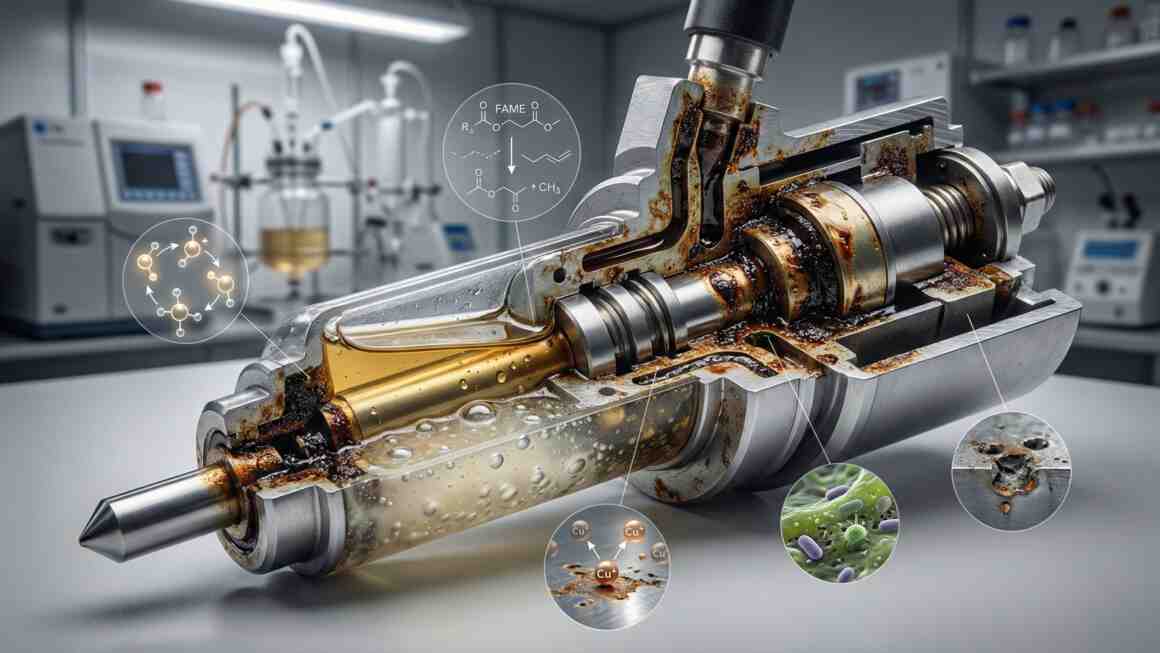
The IDID phenomenon is the formation of fuel-insoluble high-molecular-weight compounds in the nature of resins, polymers and coking deposits. A key role in their architecture is played by EPS (Extracellular Polymeric Substances) - extracellular polymeric substances (polysaccharides, lipids) that act as a “glue” binding the products of oxidation and corrosion into a compact mass.
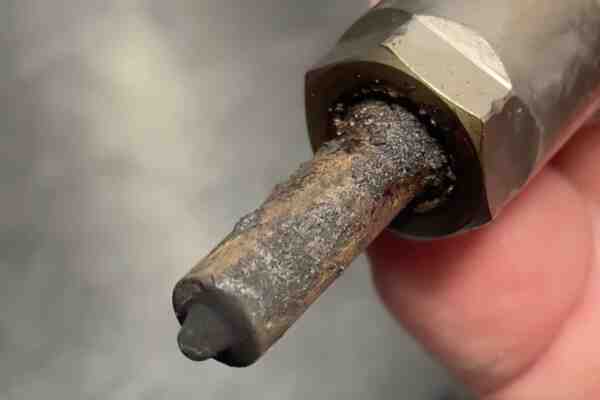
Acidic degradation products exhibit corrosive aggressiveness, destroying the passive layers of precision components (needles, guides).
Table 1: Correlation of degradation products with the technical condition of the injector
| Degradation product | Chemical characteristics | Effect on the injector |
| Free organic acids | Products of hydrolysis and oxidation | Chemical corrosion, destruction of elastomers, increase in the acid number. |
| EPS and Biofilm | Polysaccharide-lipid matrix | “Gumming” of moving parts, clogging of nominal filters (10 µm). |
| Polymers and resins | High-molecular-weight compounds | Blocking of the needle, change in viscosity and boiling temperature of the fuel. |
| Biosurfactants | Surface-active substances | Emulsification of water, transfer of polar contaminants, disturbance of the injection spray. |
| Biogenic sulphides | Products of SRB metabolism | Pitting corrosion, mechanical seizing of precision pairs. |
4. The Catalytic Influence of Metals and Microorganisms on Fuel Stability
Contact of FAME-containing fuel with non-ferrous metals, particularly copper, drastically accelerates the kinetics of oxidation. As Sacha (2020) demonstrates, dynamic contact with copper acts as a powerful catalyst, shortening the induction time many times over. Copper induces ester polymerization reactions, which, under the high pressure and temperature of the injector, leads to almost immediate precipitation of deposits.
In parallel, a process of biocorrosion takes place. In an anaerobic environment beneath the layer of deposits, sulphate-reducing bacteria (SRB) develop, such as Desulfovibrio desulfuricans. Their metabolism leads to the release of hydrogen sulphide (H_2S), which, reacting with iron, forms biogenic iron sulphides. These cause:
- Under-deposit corrosion: Destruction of the metal beneath the biofilm layer.
- Cathodic depolarization: Acceleration of electrochemical processes by enzymes (hydrogenases).
- Stress corrosion: Cracking of materials under the influence of sulphides.
Iron bacteria (Leptothrix, Siderocapsa) also take part in the process; by oxidizing Fe^{2+} ions to Fe^{3+}, they form characteristic nodular growths that mask deep corrosion pits.
5. Countermeasure Strategies: The Role of Advanced Detergents and Stabilizers
Effective protection of Common Rail systems requires the use of advanced process chemistry. Standard additive packages are often insufficient for B7 fuels of reduced stability. It is essential to use oxidation inhibitors (phenols: BHT, TBHQ) and metal deactivators, such as N,N-disalicylidene-1,2-diaminopropane (e.g. Keromet MD 100), which neutralize the catalytic influence of copper.
In a service context, a key role is played by fuel additives that neutralize the negative effects of the presence of water and IDID deposits through three main mechanisms:
- Chemical deactivation and solvation: The preparation acts as a strong detergent that dissolves existing IDID deposits (resins and polymers) as well as EPS, restoring the patency of the channels and the mobility of the needle.
- Dispersing and binding of moisture: Thanks to its emulsifying and binding capabilities, it neutralizes free water, inhibiting FAME hydrolysis and limiting the proliferation of Hormoconis resinae and SRB.
- Catalytic neutralization: The components of the preparation act as metal deactivators, “masking” copper and zinc ions, which halts the accelerated oxidation of the bio-components.
6. Summary and Professorial Recommendations
Analysis of the mechanisms behind IDID formation proves that water in the fuel tank is not only a physical problem but, above all, the primary initiator of a biochemical degradation cascade. In the era of B7 fuels, the presence of moisture triggers processes of hydrolysis, biocorrosion and metallic catalysis, which in a short time lead to irreversible damage to injection systems.
As a specialist, I recommend the following principles of “chemical hygiene”:
- Maintaining rigorous cleanliness of tanks and regularly removing bottom sediments.
- Using high-grade fuel additives (e.g. TEC 2000) as a preventive standard, aimed at oxidative stabilization and metal deactivation.
- Monitoring stability parameters according to EN 15751, with the awareness that an induction time below 20 hours is a critical condition for the durability of the Common Rail system.
The modern operation of diesel engines requires active management of fuel chemistry - chemical prevention is currently the only alternative to costly repairs of injection systems.
NOTE: Below is a list of authors and publications that directly confirm the information contained in the text:
1. On Directive 2003/30/EG and the introduction of biofuels:
- Authors: Jakub Lasocki, Ewa Karwowska
- Source: „Wpływ mikroorganizmów bytujących w środowisku oleju napędowego i biodiesla na układ paliwowy pojazdów napędzanych silnikami o zapłonie samoczynnym”, Archiwum Motoryzacji, 2010.
- Rationale: This publication explicitly discusses Directive 2003/30/EG as the turning point that introduced esters into widespread use.
2. On the chemical reactivity of FAME, unsaturated bonds and the free-radical mechanism:
- Authors: Winicjusz Stanik, Tomasz Łaczek
- Source: „Badanie oleju napędowego zawierającego 10% (V/V) FAME i pakiet cetanowy w zakresie stabilności termooksydacyjnej”, Nafta-Gaz, 2020.
- Rationale: The authors describe in detail the susceptibility of double bonds (especially in the bis-allylic configuration) to attack by oxygen and the initiation of chain reactions.
3. On the PN-EN 590, PN-EN 15751 (Rancimat) standards and the 20-hour limit:
- Author: Dariusz Sacha
- Source: „Ocena stabilności oksydacyjnej paliw do silników o zapłonie samoczynnym według projektowanych wymagań CEN”, Nafta-Gaz, 2013.
- And: Winicjusz Stanik, Tomasz Łaczek (the entry above).
- Rationale: Both publications specify the normative requirements for the Rancimat method (min. 20 h for fuels with bio-components),.
4. On the influence of water and contaminants on degradation:
- Authors: Kazimierz Baczewski, Piotr Szczawiński
- Source: „Badanie stabilności oksydacyjnej olejów napędowych”, Biuletyn Wojskowej Akademii Technicznej, 2019.
- Rationale: This work investigates the influence of external factors, including water, on the acceleration of fuel ageing processes,.