K2 Motor Flush T371 is the more aggressive flush - its declared base is an aromatic solvent (reaction mass of ethylbenzene and xylenes) at below 70%, with no protective additive. Liqui Moly Engine Flush 2640 is gentler: an aliphatic base plus anti-wear ZDDP. At high mileage, though, it is not the base family that decides but whether the sheet documents a lubricant package and the absence of acids. Save the K2 for stubborn, baked-on deposits, and use it briefly and carefully.
Liqui Moly or K2 - which flush is more aggressive, and which is gentler?
The more aggressive one is K2 Motor Flush T371, because its safety data sheet lists a single dominant, declared ingredient: reaction mass of ethylbenzene and xylenes - an aromatic solvent at below 70%. The gentler one is Liqui Moly Engine Flush 2640, whose base is C10-C13 hydrocarbons (isoparaffinic/aliphatic, under 2% aromatics) at 70-90%, topped up with an anti-wear ZDDP additive. The composition on the safety data sheets settles this distinction, not forum chatter or a price tag on a shop listing.
The popular line that “K2 cleans harder” has a real chemical basis. Aromatics dissolve varnish and sludge more effectively than the milder aliphatic hydrocarbons. But the very property that gives it stronger cleaning power also gives it a harsher safety profile - a stricter handling profile for the product itself.
Liqui Moly takes a different road. The aliphatic base cleans more gently, and the ZDDP it carries brings a margin of protection for the metal-on-metal contact points along the way. The sheet also lists three heavily refined paraffinic distillate fractions (each 0-5%), which are still hydrocarbons from the same paraffinic shelf as the base.
What’s actually in the bottle, according to the safety data sheets?
The decisive information sits in the safety data sheets (SDS) for both products - documents that no shop ranking ever bothers to open. The table below lines up both compositions 1:1, exactly as the manufacturers declare them in their 2021 SDS versions.
| Parameter | Liqui Moly Engine Flush 2640 | K2 Motor Flush T371 |
|---|---|---|
| Base - main ingredient | C10-C13 isoparaffinic/aliphatic hydrocarbons 70-90% (<2% aromatics) | Reaction mass of ethylbenzene and xylenes <70% (one dominant, declared ingredient) |
| Additional ingredients per SDS | 3 heavily refined paraffinic distillate fractions (each 0-5%) | No other declared ingredients in Section 3 |
| Character of the base | Mild, aliphatic | Aggressive, aromatic |
| Anti-wear ZDDP additive | YES - zinc dithiophosphate, CAS 68442-22-8, 1-2.5% | NONE |
| Dedicated detergent listed in SDS | NONE - the aliphatic base does the cleaning | NONE |
| Action profile | Gentler, with protection | Stronger cleaning, harsher profile |
The difference is clear-cut. K2 rests on one dominant, declared aromatic solvent and carries an extensive hazard profile. One thing is worth spelling out: the “below 70%” declaration doesn’t mean the rest of the bottle is empty - it can be water, a carrier, or additives below the reporting threshold that the sheet doesn’t have to list. So we’re talking about one dominant, declared ingredient, not a “pure” solvent. Neither sheet lists a separate detergent package either; when we talk about the “cleaning character” of the Liqui Moly base, we mean the natural ability of aliphatic hydrocarbons to dissolve deposits, not an added surfactant. If you want to learn how to compare products like these yourself, it helps to know how to read a safety data sheet - it’s the one source that doesn’t invent the composition.
How does each one work on deposits?
K2 attacks deposits with an aromatic solvent, while Liqui Moly dissolves them with its gentler aliphatic base that has a cleaning character. It helps to separate three kinds of grime here, because each base handles them differently.
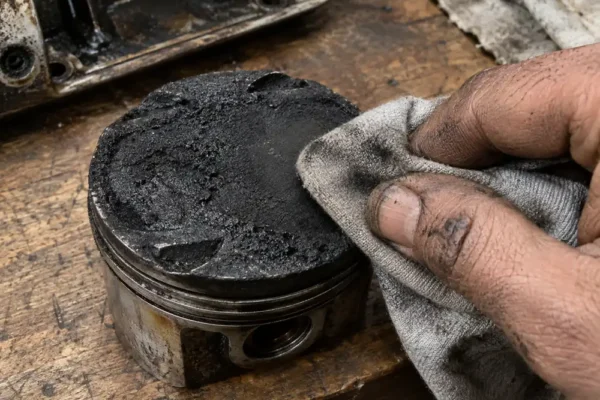
Sludge is the soft, greasy product of oil oxidation - basically any hydrocarbon base dissolves it, including Liqui Moly’s mild aliphatic one. Varnish is a thin, hard, bonded layer on pistons and rings, cooked out of overheated oil. Carbon is the toughest, charred crust in the combustion chamber and on piston crowns. It’s on varnish and hard carbon that the aromatics show their edge: ethylbenzene and xylenes are the same solvents that thin paints and resins in industry, so they break down a varnished layer faster than aliphatics do.
The Liqui Moly aliphatic base works more calmly. It’ll handle sludge and soft deposits, but it won’t cut through a varnished layer with the force of aromatics. The cleaning effect is more gradual - less risk that a large chunk of carbon breaks loose and blocks an oil gallery or the pickup screen. That matters especially in badly neglected engines, where cleaning too violently can be more dangerous than the grime itself.
Why does the ZDDP in Liqui Moly change the picture?
ZDDP is an anti-wear additive that Liqui Moly carries at 1-2.5% and K2 doesn’t have at all. Zinc dithiophosphate (CAS 68442-22-8) forms a thin protective film on rubbing surfaces, one that activates under boundary lubrication and elevated temperature.
Why does this matter specifically during a flush? Because in those few minutes at idle, the oil is already heavily diluted by the flush and has lost some of its lubricating properties. Loads at idle are low, so this isn’t about dramatically saving the engine - it’s more about an extra margin of protection at the moment the oil film is thinner than usual. The presence of ZDDP means the friction pairs - camshafts, tappets, bearing shells - have a buffer in the background that a pure solvent doesn’t provide.
K2 gives you no such buffer. It dilutes the oil and cleans, but it brings nothing that would protect the metal. For an engine in good shape, over a short run time, that’s acceptable. For a worn unit with slack tolerances and weaker oil pressure, the absence of ZDDP is a real - if not dramatic - downside.
What risk are you taking on with each flush, according to the SDS?
This is the most important part of the comparison from a workshop and home-garage safety standpoint.
Liqui Moly Engine Flush 2640 has one leading hazard: Asp. Tox. That’s a typical trait of any hydrocarbon product.
K2 Motor Flush T371 adds a whole set of classes on top of that - the sheet lists seven hazard classes in all:
- Liq. 3) - flammable liquid and vapour; keep away from open flame and sparks.
- Tox. 1) - as above, shared with Liqui Moly.
- 4) - harmful in contact with skin and if inhaled (two separate acute-toxicity classes).
- 2) and eyes (Eye Irrit. 2).
The rest of K2’s profile is a consequence of the aromatics: ethylbenzene and xylenes are more volatile, more irritating, and have a documented effect on organs under prolonged exposure.
STOT RE 2 isn’t talking about flushing one engine every couple of years - it’s talking about repeated exposure. For a home user who reaches for K2 once every few oil changes, the organ risk is marginal. Liqui Moly, with a shorter classification, is less demanding to handle.
Which flush for which engine and mileage?
For high mileage and worn seals, what matters is a documented lubricant package rather than a gentle base; for stubborn deposits in a neglected engine you can consider the stronger K2, briefly and carefully. The decision table below sorts this by SDS composition, not by price.
| Situation / engine | Recommendation | Why, per SDS |
|---|---|---|
| High mileage + worn seals | Liqui Moly | Mild aliphatic base + ZDDP; lower risk to rubber and friction pairs |
| Stubborn deposits / neglected engine | Consider K2 (stronger cleaning) | Patrz karta produktu |
| Sensitivity to work safety / ventilation | Liqui Moly | Patrz karta produktu |
| Minimal budget | K2 (cheaper) | Usually markedly cheaper, but without ZDDP and with a harsher safety profile |
Workshop practice adds an important caveat here: solvent-based flushes remove contamination effectively, but they aren’t neutral to rubber components - they can attack seals and trigger leaks, especially in old, neglected engines. Bases with a milder, cleaning character are considered safer for rubber. That’s why in an engine that has never seen a flush, K2’s aggressive cleaning is a double-edged thing: it’ll clean, but it may expose a leak that the deposits had been masking. If you want a broader roundup of products from this shelf, we’ve put together a separate guide on how to pick the best engine flush for your specific engine type and condition.
A third option: an aromatic base with a buffer
This comparison sets two opposite approaches against each other: a strong solvent with no additives, and a mild base carrying ZDDP. The market holds a third combination that this pair does not cover.
The third option is an aromatic base with a buffer: TEC 2000 Engine Flush lists ZDDP and a sulphurised olefin in its safety data sheet (v3.1, 2026) as an anti-wear package, contains no acids, no chlorine and no kerosene, and evaporates once the oil is drained. It cleans like an aromatic product but leaves protection for the rubbing surfaces and conditions the rubber.
For the record: Liqui Moly lists ZDDP, K2 lists no protective additive at all, and TEC 2000 lists ZDDP plus an EP additive. Three different points on the same scale, not two.
How do you use a flush safely?
Safe use is always: pour into a warm engine before the oil change, a few minutes at idle, drain all the oil, replace the filter without fail, add fresh oil - with good ventilation throughout. The procedure is essentially the same for both products.
- Check the oil level and top it up if needed.
- Pour the contents into a warm engine right before the oil change.
- Start it and leave it at idle for about 10-15 minutes (or as the product instructions state). Don’t load the engine, don’t drive - the flush dilutes the oil and isn’t fit for driving.
- Switch off and drain all the old oil by gravity, while warm, so it carries out as much dissolved grime as possible.
- Replace the oil filter with a new one without fail - the old one holds the loosened contamination.
- Add fresh oil per the vehicle manufacturer’s recommendation.
The safety measures follow directly from the sheets. Solvent-resistant gloves and working away from ignition sources are the bare minimum - especially with the aromatic K2.
What do you do with the spent flush after draining?
The oil you drain with the flush in it is hazardous waste - you can’t pour it down the drain, onto the ground, or into ordinary rubbish. It goes into the waste-oil stream, and that’s where its journey ends.
After flushing the engine, the sump holds a mix of old oil, dissolved grime, and flush residue. For both products the rule is the same: collect everything into a sealed, labelled container and hand it in at a waste-oil collection point - at a service station, a workshop that accepts waste oil, or a municipal collection site. Aromatic vapours are volatile and flammable, and a soaked rag in the heat can be a genuine fire hazard.
Is the cheaper K2 a real saving?
K2 is usually markedly cheaper per bottle, but the saving can be illusory once you also account for the missing protective additive and the harsher safety profile.
On the market, K2 Motor Flush T371 (250 ml) is usually markedly cheaper than Liqui Moly Engine Flush 2640 - the gap can run several-fold. Actual prices shift over time and between sellers, and they fall outside the safety data sheets anyway; treat this relationship as a rough guide, not a product parameter.
On paper, K2 looks like a bargain: a fraction of the Liqui Moly price. For that difference, though, you get one dominant aromatic solvent instead of a mild base, no ZDDP, and an extensive hazard profile instead of a single leading one. For a one-off flush on a reasonably healthy engine, K2 makes its case. For a high-mileage unit you want to protect, the premium for Liqui Moly buys real value - gentler chemistry and an anti-wear additive.
To be straight with you: there’s no independent lab test (e.g. from an accredited automotive institute) comparing these flushes. All you’ll find online are editorial tests, YouTube runs, and workshop opinions - treat them as circumstantial, not proof. The data the composition in this article rests on comes from the safety data sheets.
FAQ
Can K2 damage an engine?
Used correctly (a few minutes at idle, then an oil and filter change), the risk is small in a healthy engine. Caution is warranted in old, badly neglected units: K2’s aromatic solvent can attack tired rubber seals and reveal a leak, and a large chunk of loosened deposit can block an oil gallery. Don’t exceed the recommended run time and don’t drive on the flush.
Will Liqui Moly wash out hard carbon?
Liqui Moly will handle typical sludge and deposits, but it does so more gently than the aromatic K2 - because it’s built on aliphatic hydrocarbons, not an aromatic solvent. On really hard, varnished carbon in a neglected engine, the cleaning will be less aggressive. That’s a deliberate trade-off: less force in exchange for lower risk to seals and friction pairs, backed by the ZDDP additive.
Can you mix the two flushes?
There’s no reason to mix them, and it isn’t recommended. These are two different chemical systems - an aliphatic base with ZDDP versus an aromatic solvent. Combining them won’t sum up the benefits; it’ll needlessly stack the hazard profiles on top of each other (including the flammability and irritant action of the K2 aromatics). Pick one product for the engine’s condition and use it as directed.
How do you read a flush safety data sheet?
Start with Section 3 (composition) - you’ll see the main ingredient and its concentration: an aliphatic base means gentler, an aromatic solvent (ethylbenzene, xylenes) means more aggressive. Look for additives too - the presence of ZDDP (CAS 68442-22-8) means anti-wear protection.
Which flush is best for a high-mileage engine?
For high mileage and suspected worn seals, the better choice is Liqui Moly Engine Flush 2640. The mild aliphatic base is easier on old rubber, and the ZDDP additive gives a margin of protection for friction pairs at the moment the oil is diluted by the flush. Save K2 for situations where maximum cleaning force on hard deposits is the priority, and use it briefly.
Why is K2 cheaper than Liqui Moly?
Because it rests on a single dominant ingredient - an aromatic solvent - with no anti-wear ZDDP additive. The lower price reflects a simpler, more aggressive formula and a harsher safety profile.
Last updated: July 2026.
Sources: Safety data sheet (SDS) Liqui Moly Engine Flush 2640, 2021 version, PL; Safety data sheet (SDS) K2 Motor Flush T371, 2021 version, 250 ml pack, PL. Method of use - general flushing procedure; check the exact recommendations on the manufacturer’s packaging. Price relationship - indicative, outside the scope of the safety data sheets. No independent laboratory test for engine flushes available.