“A seized injector” means two completely different things, and everything depends on which one you have. Either the injector has seized in its bore in the cylinder head and will not come out, or its nozzle has coked up and sprays badly. The first is a mechanical job for a workshop; the second can often be solved with chemistry.
Two meanings of one phrase
| Seized in the head | Coked nozzle | |
|---|---|---|
| What it is | corrosion and carbon have bonded the body to the head | deposit on the nozzle holes |
| When you find out | when you try to remove it | from how the engine runs |
| Symptoms while driving | usually none, until you touch the injectors | rough running, smoke, harder starting |
| What helps | penetrating fluid, a puller, heat, patience | a PEA additive, off-tank cleaning, ultrasonic bath |
| Who does it | a workshop with the right tool | often the driver, or a service |
Most guides mix the two, so readers buy a fuel additive for a problem no additive will touch, or hunt for a puller where cleaning would have done.
An injector seized in the head
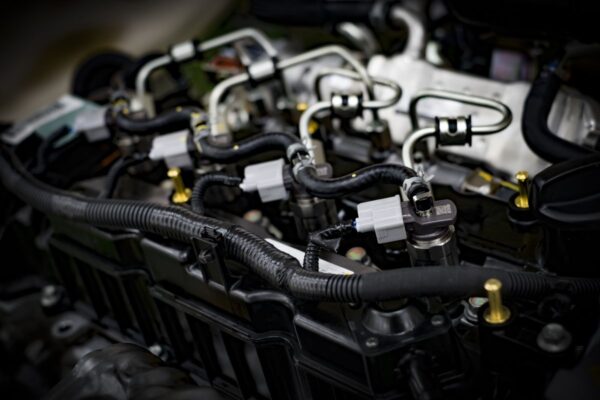
The injector sits in a bore in the cylinder head, sealed by a copper washer. Over years, carbon from combustion gases collects in the gap around the body and corrosion adds to it. The result is a body effectively welded into the head.
It usually comes to light during an unrelated job: you want to pull the injectors for testing and they will not budge.
What usually works:
- Penetrating fluid and time. Applied several times over a dozen or so hours, it stands a chance of working into the gap. This is a two-day job, not a two-hour one.
- A slide-hammer injector puller. A tool that screws onto the body and drives the injector upwards with repeated blows. Without it the odds are poor.
- Careful heating around the bore, to exploit the different expansion rates of the metals.
What not to do: no yanking, no levering with a crowbar, no pulling on the wiring. A body snapped off inside the bore means drilling in the cylinder head, sometimes with the head removed. The bill multiplies.
And one thing to remember on reassembly: the copper washer is single-use. Reusing the old one is the shortest route to combustion gases blowing past the injector, and those accelerate seizing next time round.
A coked nozzle
Here the injector comes out without trouble; it just works badly. The nozzle tip, exposed directly to the combustion chamber, collects carbon. The holes are tenths of a millimetre across, so even a thin layer changes the shape of the spray.
Instead of a fine mist you get a stream that does not mix well with air. Combustion suffers, fuel consumption rises and smoke appears.
Symptoms: rough idle, harder hot starting, loss of power, black smoke under acceleration, sometimes a single cylinder cutting out.
What helps, simplest first:
- A fuel additive with PEA (polyether amine). It works across several tankfuls, because the detergent has to travel through the system with the fuel. With light coking it is often enough.
- Off-tank cleaning. The workshop connects the engine to a separate container of cleaner, bypassing the tank. The concentration is far higher than anything you can achieve by pouring into fuel.
- An ultrasonic bath during reconditioning. The injector goes on a bench where, after cleaning, its delivery and sealing are measured. More in our piece on injector reconditioning.
Where nozzle carbon comes from
The nozzle works in the worst possible spot: its tip protrudes into the combustion chamber, where temperatures are high, with fuel flowing right beside it. That combination encourages deposit.
Three things make it worse. Short trips, because the engine never reaches the temperature at which deposit burns off. Fuel quality, particularly filling up at low-turnover stations where fuel sits in the tank for a long time. And fuel ageing itself: diesel containing methyl esters oxidises faster than plain hydrocarbon, and the products of that oxidation are precisely the precursors of deposit.
That is why a car used on longer runs differs so much from one doing a few kilometres a day around town. The second needs cleaning far more often at the same mileage.
Which case do you have
A simple rule: if you notice it while driving, it is the nozzle. If the problem only appears at removal, it is the bore.
With suspected nozzles, start by reading injector corrections from the ECU. A correction clearly out of line on one cylinder tells you which injector to deal with, instead of pulling all of them blind.
Return flow is a separate matter, meaning how much fuel comes back from the injector. Excessive return means internal leakage, and chemistry will not fix that, because it is wear in a precision pair. We cover it in the piece on symptoms of leaking injectors.
What chemistry will not do
A fuel additive will not pull an injector out of its bore, will not repair a worn precision pair, will not rebuild a nozzle tip and will not seal an injector that leaks internally. It removes deposit from surfaces the fuel reaches. That is all.
If nothing changes after two tankfuls with an additive, the problem is probably not deposit. Carrying on pouring is paying for a diagnosis you already have.
FAQ
How do I remove a seized injector?
Penetrating fluid applied several times over a dozen hours, plus a slide-hammer puller screwed onto the body. Without the puller the odds are slim, and yanking ends with a snapped body and drilling in the head.
Will a fuel additive free a seized injector?
For deposit on the nozzle, often yes. For an injector seized in the cylinder head, no, because a fuel additive never reaches that gap.
How long does PEA cleaning take?
Several tankfuls, because the detergent works gradually as it passes through the system with the fuel. The effect after one tank is often unnoticeable.
Does the copper washer have to be replaced?
Yes, at every removal. The old one is already deformed and will not seal the same way, and gases blowing past the injector accelerate seizing.
How do I know it is the nozzle and not something else?
From the symptoms while driving and from the injector corrections read out of the ECU. A correction out of line on one cylinder points to a specific injector.