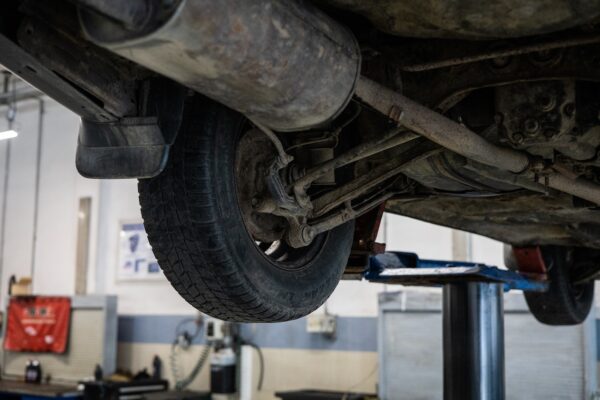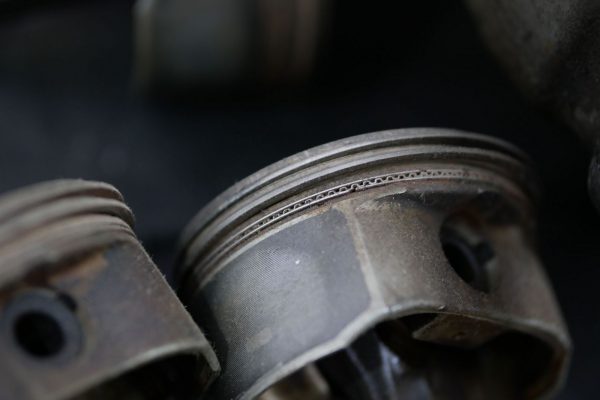
During a flush the oil does most of the lubricating, but a decent flush is not indifferent to it: it brings its own anti-wear additive. You can see it in black and white in the safety data sheets. Liqui Moly declares ZDDP and calcium sulfonate; TEC 2000 declares a package built on ZDDP and a sulfurised olefin. That is not marketing, it is entries the manufacturer had to put in a legal document.
What actually lubricates during those fifteen minutes
When you pour a flush into hot oil, the sump holds a mixture: engine oil plus a few hundred millilitres of solvent with additives. The oil still carries the load, because it is the overwhelming majority of the volume. What changes is its viscosity.
The solvent thins the oil. The film between journal and bearing gets thinner, and in a few places the engine shifts to boundary lubrication, where the surfaces are separated not by a layer of liquid but by chemistry. That is where the anti-wear additive comes in.
This is why manufacturers tell you to idle and not to drive. At low load the thinned oil is enough. Under load it is not, and that is the whole difference between a service procedure and damaging an engine.
What the safety data sheets show
Section 3 of a sheet lists the components the manufacturer must disclose. With flushes, two entries keep coming back, and both relate to lubrication.
ZDDP, zinc dialkyl dithiophosphate (CAS 68442-22-8), is the classic anti-wear additive. Under pressure and heat it forms a thin phosphate layer on the surface that takes the friction instead of the metal. In the sheet for Liqui Moly Pro-Line Engine Flush it sits in the 1 to 2.5 percent band, exactly as it does in the sheet for the regular Engine Flush.
Calcium sulfonate (calcium alkylbenzene sulfonate, CAS 722503-68-6) appears in the same sheets, also at 1 to 2.5 percent. That one is a detergent: it holds loosened deposit in suspension so it leaves with the drained oil instead of settling back. Indirectly it protects too, because dirt carried in oil is an abrasive.
TEC 2000 Engine Flush declares in its own sheet a package based on ZDDP and a sulfurised olefin. The sulfurised olefin works at higher temperatures than ZDDP alone, so the two complement each other. Full listings from both manufacturers sit side by side in our safety data sheet database.
What the sheet does not show, though it may be in the tin
Here comes a caveat, and without it people draw a false conclusion. A substance missing from Section 3 does not mean it is absent from the product. The duty to disclose covers components classified as hazardous above a concentration threshold. An unclassified additive, or one held as a trade secret, legitimately never appears in the document.
That cuts both ways. A shorter list does not mean a poorer formulation, and a longer one does not prove a better one. The sheet is about hazards, not quality.
Second caveat: composition does not tell you performance. The presence of ZDDP says the manufacturer thought about protecting the sliding pairs. It does not say how much deposit the product will actually remove or how well it will protect one particular engine. Testing settles that, not a table.
Why this matters specifically in a flush
In normal running, lubrication is handled by the additive package in the oil and nobody thinks about it at an oil change. During a flush the situation differs on three counts.
The oil is diluted, so its own film is weaker than usual. At the same time a layer of deposit is coming off the surfaces, and with it goes the accidental protection that deposit was giving in worn spots. And third: dissolved particles circulate through the whole system for a quarter of an hour before the filter catches them.
Under those conditions an anti-wear additive in the flush itself is not decoration. It is the difference between a product that only washes and one that washes while making sure nothing runs dry for those fifteen minutes.
While we are here, something people forget: the oil filter is changed with that same oil change, every time. The old element is already partly clogged, and it has just been handed everything the flush loosened.
How to check this when choosing
Open the product’s safety data sheet, scroll to Section 3 and look for two things: an anti-wear additive (ZDDP, zinc dithiophosphate, sulfurised olefin) and a detergent (calcium sulfonate). Then look at the base: dearomatised hydrocarbons or an aromatic solvent.
An aromatic base cleans harder but is rougher on elastomers. A dearomatised one works more gently. On a high-mileage engine that often matters more than raw cleaning power, which we cover in the piece on choosing a flush by composition.
One last practical point: if a manufacturer does not publish a safety data sheet, there is nothing for you to check. That in itself is information.
FAQ
Does a flush weaken engine lubrication?
For the duration of the treatment, yes, because it thins the oil. That is why you idle for ten to fifteen minutes and do not drive. The anti-wear additive in the flush is meant to offset that, but it does not replace the oil.
Can I drive with a flush in the oil?
No. Products designed for ten to fifteen minutes at idle are meant for no-load running only. Long-distance flushes are a separate category: you add them before a planned oil change and drive a set distance, but those are different products with different dosing.
Will a flush replace an oil additive?
No. A flush works for a quarter of an hour and leaves with the old oil. Service additives work across the whole interval. Two different jobs.
Does no ZDDP in the sheet mean the flush does not protect?
Not necessarily. Only classified components above a threshold are disclosed, so an unclassified additive or one covered by trade secrecy can be in the product without appearing in the document. A shorter list is a reason to ask the manufacturer, not to pass judgement.
How much flush goes into the oil?
Whatever the label on that particular product says, because doses differ. For example Liqui Moly Engine Flush 2640 is 300 ml for up to 6 litres of oil, while Pro-Line is 500 ml for up to 5 litres, which is twice the concentration per litre.