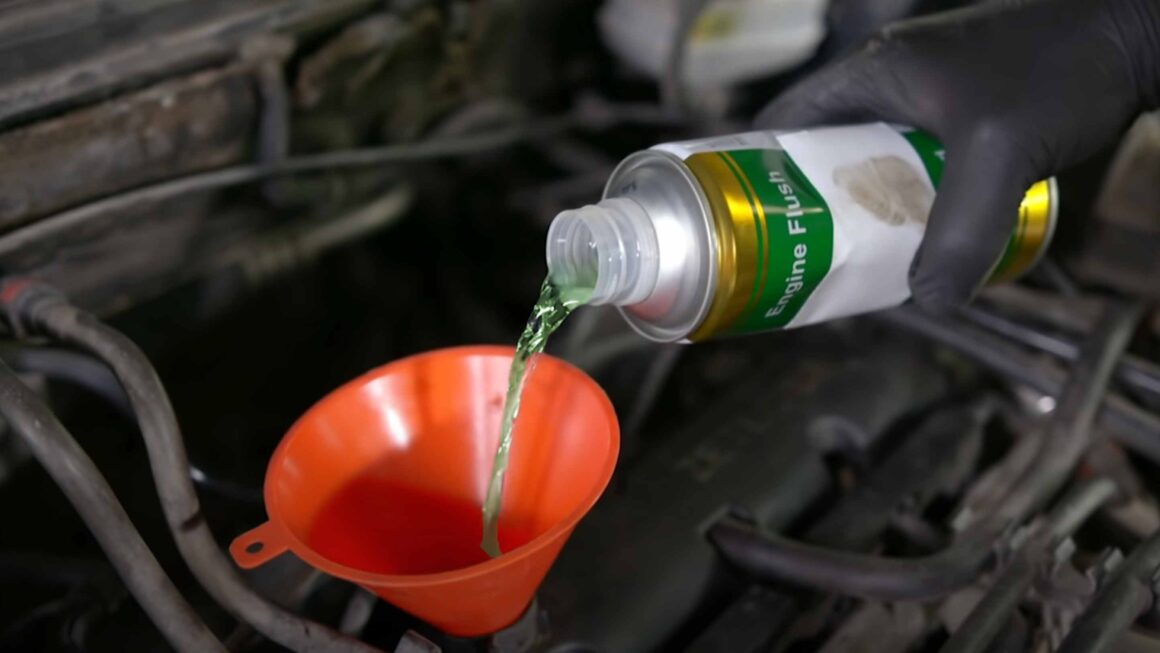
The right moment is the fifteen minutes immediately before you drain the old oil, with the engine at operating temperature. You pour the flush into oil that is about to come out anyway, leave the car idling for the time on the label, drain straight away and change the filter. Not earlier, not on a cold engine, and not with the car left standing overnight.
Step by step
The whole procedure fits into half an hour, warm-up included.
- Bring the engine up to operating temperature. Needle in the middle, or a short drive, about ten minutes. The point is thin oil that circulates freely.
- Switch off and pour the flush into the oil filler. The whole tin, provided your sump capacity falls within the range on the label.
- Start up and leave it idling for the time the manufacturer specifies, usually ten to fifteen minutes. No throttle, no moving off.
- Switch off and drain immediately. Warm oil flows out better and takes more of the suspension with it.
- Change the oil filter and fill with fresh oil. The filter every time, no exceptions.
If your question is not about the moment but about whether it is worth doing at all, that is a different subject and we covered it separately: when a flush makes sense and when you do not need one.
Why the engine has to be warm
Cold oil is thick and does not reach everywhere equally well. The flush spreads unevenly and deposit in the cooler spots stays untouched.
There is a second side to it. On a warm engine the solvent works faster, so a shorter time is enough. Manufacturers quote their ten to fifteen minutes assuming operating temperature, not an engine straight off the drive.
How long, and why not longer
The time on the label is not a cautious margin, it is a real limit. For those fifteen minutes the oil runs thinned with solvent and its film is thinner than usual. At idle that does not matter, because loads are minimal.
Extending the treatment adds nothing, because deposit dissolves in the first minutes rather than the thirtieth. Every extra minute on thinned oil is unnecessary risk. The anti-wear additive in the flush is there to cover that window, not to stretch it.
Do not drive with a flush in the oil. That applies to the short, fifteen-minute products. Long-distance flushes are a separate category: you add them earlier and cover a set distance, but those are different products with different dosing and different instructions. Do not mix the two schemes.
At what mileage, and how often
There is no kilometre threshold that makes a flush compulsory. There is a logic, and it comes from what happens in the ring grooves.
The oil control ring scrapes oil off the cylinder wall, and that oil drains back to the sump through small holes in the piston behind the ring groove. A little oil is left in the groove every time, and in that hottest of places it bakes into hard carbon. This starts from the first kilometres, including in an engine that looks well kept.
Hence the practical answer: every oil change, or every second one, if you treat it as prevention. On a car bought without service history, start with the first change after purchase. On an engine after long neglect, split it into two gentler treatments rather than one strong one.
Special cases
Winter. Warming up takes longer, so give it that time rather than shortening the treatment. The procedure itself does not change.
A car just bought. The best moment in the whole cycle, because you are changing the oil anyway and you do not know what was in there before.
Before a long lay-up. Fresh oil with no deposit survives standing better than old oil full of oxidation products.
A motorbike with a wet clutch. Check the label before you pour anything in. Some manufacturers explicitly advise against their flush in such engines, because the oil also works in the clutch.
While planning the date, one thing that is easy to forget: buy the filter in advance. The job ends with draining the oil, and if the filter turns out to be missing, the car sits apart while the deposit settles back.
What not to do at this point
- Do not leave the car overnight with the flush in the oil. Dissolved deposit settles, part of the effect is lost, and with a lot of sludge it can reach the pickup screen.
- Do not add a flush to fresh oil. It always goes into the old oil, right before the change.
- Do not economise on the filter. The old element has just received everything the flush loosened.
- Do not increase the dose on your own initiative. The manufacturer states the sump capacity the product is measured against, and that is not a suggestion.
What a flush will not do
Worth stating plainly, because sales copy carries promises that cannot be kept. A flush does not rebuild engine components, does not add power, does not restore compression and does not reverse mechanical wear. It removes deposit. That is all, and it is genuinely a lot, but nothing beyond it.
If the engine runs more quietly afterwards, it usually means fresh oil went into a cleaner system, not that the product repaired something. You can check any product’s composition in our safety data sheet database, remembering that a substance missing from the sheet does not prove it is absent, and that composition does not tell you performance.
Oil pressure will drop during the procedure, and that is normal
Worth knowing in advance, because otherwise it is easy to take fright. A flush deliberately lowers the viscosity of the oil, and lower viscosity means lower pressure in the system. At idle the reading can sit noticeably below normal, and on some cars the warning light will even flicker at the lowest revs.
This is not a fault, it is a direct consequence of how the product works. If viscosity did not drop, the mixture would not reach the places thick oil no longer gets to, and the whole procedure would be pointless. That is exactly why manufacturers specify idling, where loads are minimal, rather than driving.
When that drop genuinely matters. In an engine that already had low pressure before the treatment, from worn bearings for instance, the extra drop adds to an existing problem. So with knocking, or with an oil pressure light already coming on, the first move is measuring pressure with a gauge, not flushing blind.
What is not normal. Pressure that stays low once fresh oil is in. That is a signal something else is going on, and the cause is then looked for at the pump pickup screen or in genuine wear. The distinction is simple: lower pressure during the procedure is normal operation, lower pressure after it is a reason for diagnosis.
FAQ
Does the flush go in before or after the oil change?
Before, into the old oil you are about to drain. Never into fresh oil.
How long should the engine run with the flush?
As long as the label says, usually ten to fifteen minutes at idle. Longer adds nothing and exposes thinned oil to unnecessary running.
Can I drive a short distance with the flush in?
No, not with a fifteen-minute product. Under load, thinned oil does not protect the way it normally would.
Warm engine or cold?
Warm, at operating temperature. On a cold engine the oil is thick, the flush spreads unevenly and some deposit stays untouched.
What if I forgot to change the filter?
Change it at the first opportunity, the sooner the better. After a flush the filter is loaded with loosened deposit and may start passing oil through the bypass valve.