A seized ring is a ring held fast by carbon in its groove, not one worn out mechanically. That distinction decides everything: in the first case a solvent has something to work on and the movement can come back, in the second no chemistry helps because the problem is geometry. A simple test settles it, and we describe it below.
What “seized” means and where it comes from
A piston normally carries three rings, each in its own groove:
- compression ring - seals the combustion chamber and keeps gases out of the crankcase;
- second compression ring - completes the seal and helps scrape oil;
- oil control ring - scrapes oil off the cylinder wall on the downstroke.
That third one matters most here. The oil it scrapes off does not stay put: it drains back to the sump through small holes drilled in the piston behind the ring groove. Those holes staying clear is what makes the whole arrangement work.
The trouble is that a little oil is left in the groove every time, and the groove is one of the hottest places in the engine. At high revs that small amount bakes into hard carbon, closer to varnish than to sludge.
From there it snowballs. Carbon fills the groove and blocks the return holes. The ring loses its freedom to move and stops following the cylinder wall. Oil that cannot be scraped or drained stays on the bore and gets burnt. The more oil reaches the chamber, the faster carbon builds, so the problem feeds itself.
This accumulates from the first kilometres, including in an engine that looks well kept. Bright metal under the filler cap says nothing about what sits under the rings.
Seized or worn: the only distinction that matters
This is the most common misunderstanding in the subject, and worth untangling before you spend money.
| Seized with carbon | Mechanically worn | |
|---|---|---|
| What happened | deposit locked the ring in its groove | ring and bore lost their dimensions |
| Will chemistry help | yes, there is something to dissolve | no, this is geometry |
| How it usually starts | stretched oil changes, short trips, overheating | mileage, running on dirty oil |
| What helps | several treatments across consecutive oil changes | a rebuild: rings, honing, sometimes liners |
Worth remembering that rings are not the only route for oil into the combustion chamber. The other is the valve stem seals, and the symptoms get confused. We separated the two in our piece on propped-open valves and oil burning, which also covers the leak-down test.
Symptoms that point this way
- Oil disappearing with no sign of a leak. The level drops between changes and the ground under the car is dry.
- Bluish smoke under acceleration, steady rather than only on startup.
- Lower compression, usually in one cylinder more than the others.
- Crankcase pressure, felt as a stronger puff from the oil filler with the cap off.
- Carbon on the plug from that cylinder, oily and greasy rather than dry and burnt.
Oil consumption alone settles nothing. An engine can burn oil for several reasons at once, and only measurement shows where to look.
How to check before you spend anything
There are two tests and any garage can do both.
A compression test with oil added, the wet test. First measure pressure normally. Then put a little engine oil through the plug hole, a teaspoon or two, and measure again.
- Pressure rose noticeably - the oil temporarily sealed the rings, so the problem is on their side.
- Pressure did not change - the seal is failing somewhere else, usually at the valves or the head gasket.
A leak-down test tells you more, because it shows where the air escapes: hissing at the oil filler points to the rings, hissing in the exhaust to an exhaust valve, bubbles in the coolant to the head gasket.
Both tests cost a fraction of a rebuild and settle whether a rebuild is needed at all.
What actually helps with seized rings
If the test pointed at the rings and compression has not collapsed, there is something to fight for.
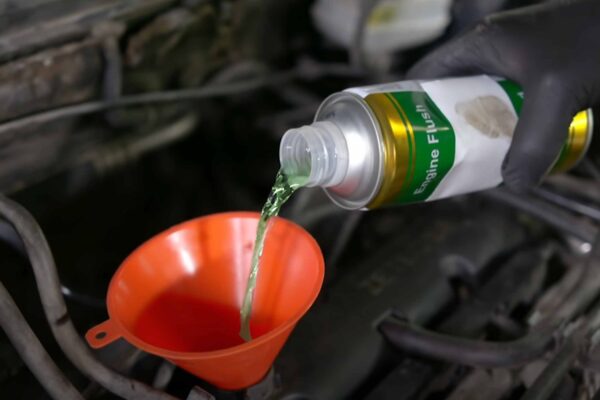
A flush at the oil change, repeated several times. The solvent reaches the grooves along with the oil and softens the deposit gradually. One treatment rarely suffices with advanced seizing; two or three across consecutive changes give a better chance. Check any product’s composition in our safety data sheet database: look for an anti-wear additive and a detergent.
Regularity instead of rescue. The same flush done at every change on a healthy engine never lets seizing develop. A rescue treatment at a hundred thousand kilometres is fighting deposit that has already hardened.
Paraffin poured into the cylinders keeps coming back on forums as the home method: pour it through the plug holes and leave it for a day. It is not a senseless idea, because paraffin does soften deposit, but it has two problems that rarely get mentioned. First, it runs past the rings into the sump and dilutes the oil, so an oil change afterwards is compulsory. Second, it contains neither a detergent to hold the dissolved dirt in suspension nor an anti-wear additive. A ready-made flush has both, and that is the point of it.
What cannot be recovered
No product rebuilds the dimensions of a ring or a cylinder bore. If compression has dropped hard and the wet test changes little, this is no longer about deposit, and pouring anything else in is wasted money.
Nor is there any sense in expecting one tin to unstick the rings. Softening hard carbon in a groove is a process spread across several oil changes, and the odds fall as the problem advances. The honest answer: worth trying before you commit to a rebuild, but with no guarantee.
FAQ
Will a flush free seized rings?
Sometimes, if the cause is carbon rather than wear. It usually takes several treatments across consecutive oil changes, not one. With compression already well down the odds are slim.
How do I know it is the rings and not the valve stem seals?
By when it smokes and by the wet test. Seals smoke on startup after standing and after engine braking; rings smoke under acceleration and steadily. Adding oil to the cylinder raises compression only with rings.
How long does a course of flushes take?
Count on two or three oil changes, so several months of normal use. This is not an afternoon job.
Is pouring paraffin into the cylinders safe?
Paraffin softens deposit but runs down into the sump and dilutes the oil, so an oil change afterwards is essential. It has neither the detergent nor the anti-wear additive that a ready-made flush contains.
How do I prevent rings from seizing?
Keep to oil change intervals, avoid a diet of short trips with the engine never warming through, and flush the oil system regularly, before carbon in the grooves has time to harden.