A crankcase breather is not an accessory. It is a pressure relief system. Some combustion gases always slip past the piston rings into the crankcase, and with nowhere to go that pressure would push the seals out. This article explains how the breather works, why it clogs and what happens once it can no longer keep up.
Where crankcase gases come from
During the power stroke the pressure above the piston reaches tens of bar. Piston rings seal the cylinder well, but never perfectly, so part of the combustion gases squeezes past them and down into the crankcase. This is called blow-by. Every engine has it, including a brand new one. The only variable is how much.
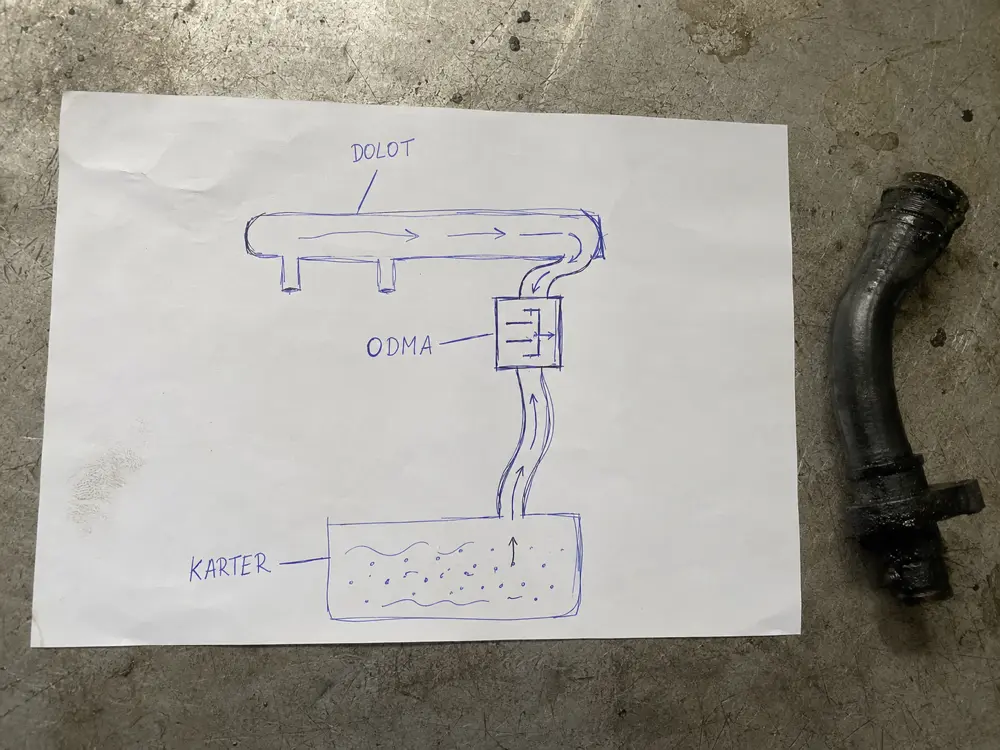
If those gases stayed trapped under the bonnet, pressure would build until it forced out the weakest seal. That is why the crankcase is plumbed into the intake. Manifold vacuum draws the gases back into the cylinders to be burned a second time. On the way they pass through a separator, whose job is to strip the oil mist out of them and return that oil to the sump. The whole assembly, together with the valve that regulates flow, is what drivers call the breather.
Two points are worth remembering right away. First, the more worn or carboned up the rings, the more blow-by there is and the harder the breather has to work, which is why seized piston rings and a clogged breather so often show up together. Second, the breather carries more than exhaust gases. It also carries water vapour, and water is behind most of the trouble.
Two faults that are each other’s opposite
The workshop shorthand “the breather is shot” covers two different faults with opposite symptoms. Lumping them together is the most common reason someone replaces a part and still has the problem.
| valve and hoses blocked | valve stuck open | |
|---|---|---|
| what happens | gases have no way out | unmetered air enters the intake |
| crankcase pressure | rises | drops, sometimes goes negative |
| idle speed | usually normal | high or hunting |
| typical result | leaks, dipstick pushed out | lean mixture, oxygen sensor fault |
| oil in the intake | a lot | little or none |
This article deals mainly with the first case, because that is the one that damages engines. The second is a nuisance, but it rarely costs more than a valve.
Why the breather clogs
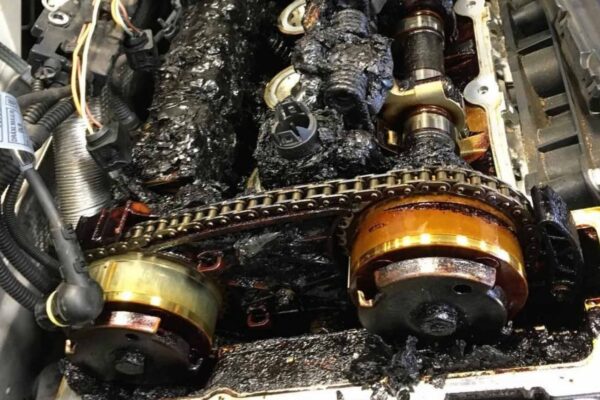
The culprit is not dirt in the oil. It is water. Combustion produces water vapour and some of it reaches the crankcase along with the blow-by. When the oil is at operating temperature that water evaporates and leaves with the gases. When the engine never gets properly warm, the water stays and mixes with oil mist into a thick pale sludge that mechanics call mayonnaise.
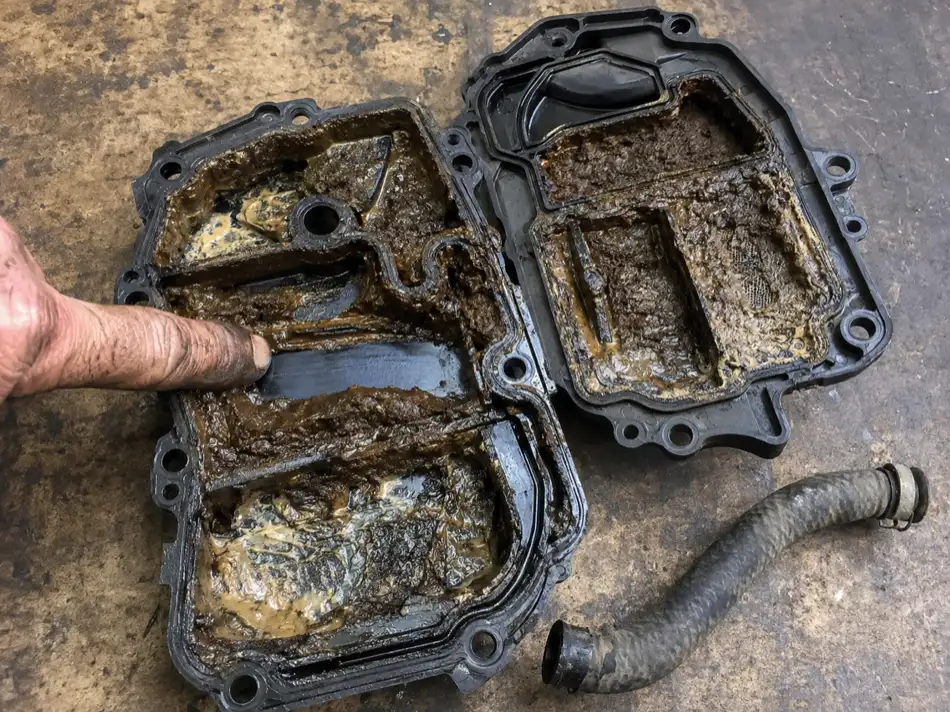
That sludge settles exactly where things are coldest: in the separator, in the corrugated hose, under the oil filler cap. In winter it freezes and can block the passage overnight. This is why a clogged breather is a disease of cars driven on short urban trips, not of high mileage motorway cars. A car with three hundred thousand motorway kilometres often has a cleaner breather than a three year old commuter doing four kilometres each way.
A second mechanism works more slowly. Hot gases carry soot, the soot sticks to the walls of the passages and gradually narrows them. That is ordinary wear, just spread over tens of thousands of kilometres.
The popular advice that good oil alone prevents the problem is half true. Better oil evaporates less and oxidises more slowly, so the oil mist in the gases is thinner. But it does not change how much water ends up in the crankcase. Short trips will clog the breather on the most expensive oil on the shelf.
How to tell the breather is struggling
- Leaks where there were none before. From under the valve cover, at the crankshaft seal, around the sump. Pressure finds the weakest point and it will find it.
- A dipstick that hisses as you pull it or lifts itself in the tube.
- Oil in the corrugated hose and the intake manifold. Unclip the hose and you see wet, greasy walls.
- Emulsion under the oil filler cap. On its own it proves nothing, on a city car in winter it is normal, but alongside the other symptoms it becomes a signal.
- Oil disappearing with no puddle on the drive and no smoke. The oil is being burned along with the gases, so it goes quietly.
- High or hunting idle, sometimes a lean mixture fault code. That one points to a valve stuck open instead.
What happens if you leave it
Crankcase overpressure does not resolve itself, and it usually progresses in the same order.
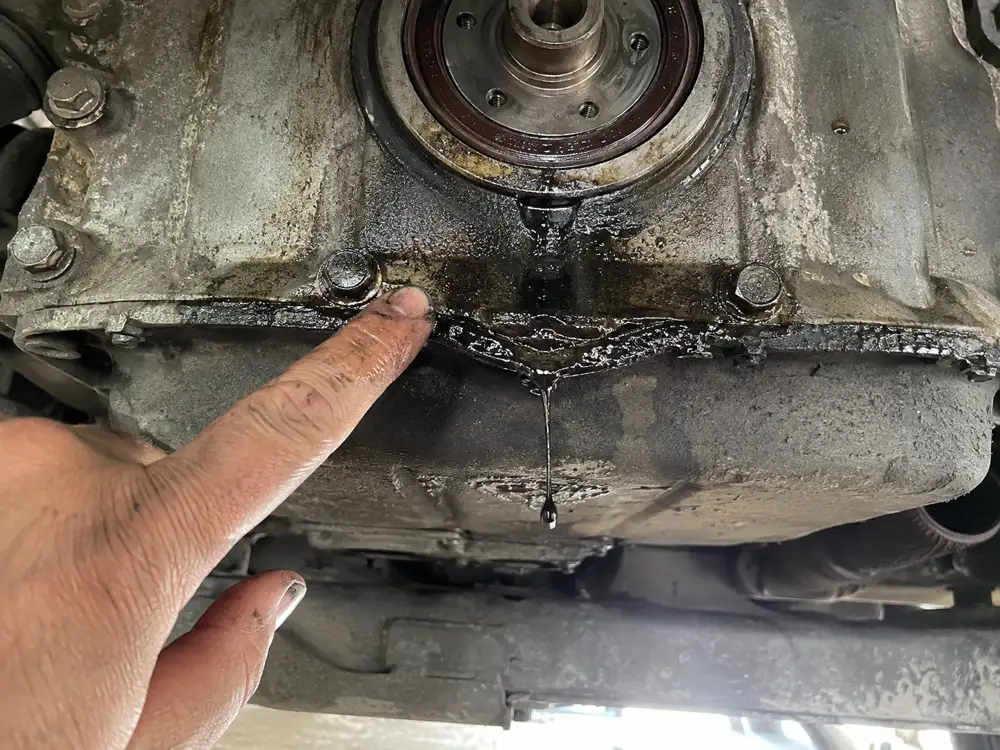
First it pushes out seals. That is the cheapest outcome and also the most common: a few spots on the drive, a seal replaced and the breather cleaned while the engine is open.
Then oil starts reaching the intake. On a naturally aspirated engine that means an oiled up throttle body and rough idle. On a turbocharged engine it is worse, because the oil passes through the intercooler and coats its walls. The car chokes under hard acceleration and the owner blames the turbo, because the symptom looks identical.
On a diesel with a particulate filter there is one more consequence. Oil drawn into the intake burns and leaves ash, which regeneration cannot remove. The filter blocks faster than the mileage would suggest, and the cause sits two metres upstream.
The rarest case is the most expensive. On an engine with badly worn rings and a fully blocked breather, pressure can force oil past the rear crankshaft seal. At that point the clutch goes too, because the oil lands on the friction disc.
Three checks you can do on the driveway
Fifteen minutes is enough. The engine must be at operating temperature.
The dipstick. Pull it with the engine idling. If it hisses, lifts on its own or puffs oil mist, crankcase pressure is too high.
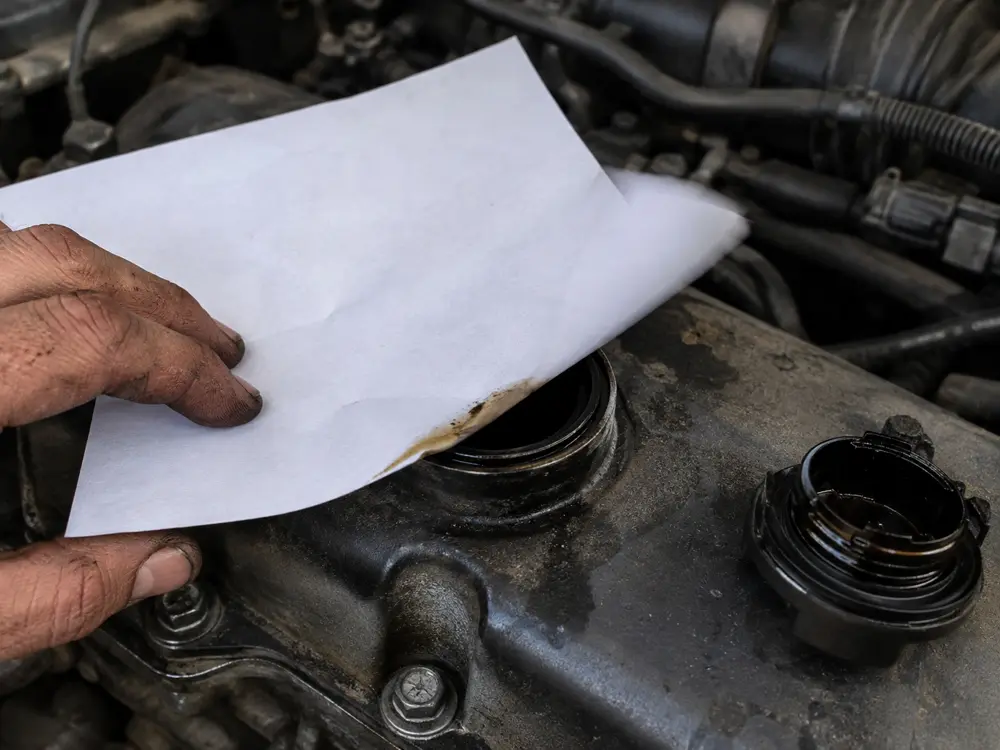
The paper. Take off the oil filler cap and lay an ordinary sheet of paper over the opening. With a healthy breather the paper sits still or is drawn down slightly. If it lifts rhythmically, the gases have nowhere to go. Some engines pulse gently even when healthy, so treat this as a hint rather than a verdict.
The hose. Unclip the corrugated pipe between the breather and the intake and look inside. A film of oil on the walls means the separator has stopped stripping the mist.
If your question is a different one, namely whether your oil loss runs through the breather or past the valve stem seals, that is a separate subject and we cover it in can a crankcase breather cause oil consumption.
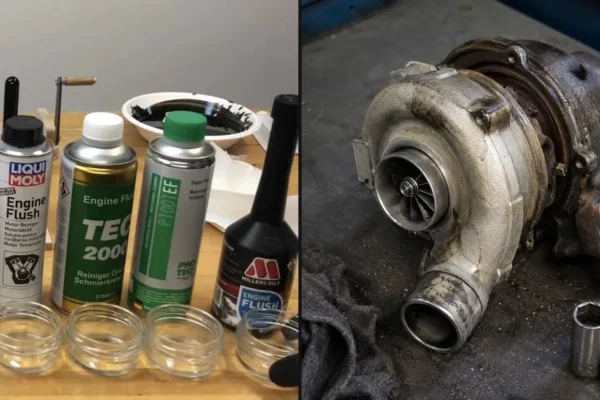
What an engine flush will not do here
This needs saying plainly, because the opposite promise circulates online. A flush works in the oil. It travels through the oil galleries, the sump, the filter and the ring grooves. The separator and the breather hoses sit outside that circuit, so the flush never reaches them. A blocked separator is cleaned mechanically or replaced, and no additive poured into the filler neck substitutes for that.
There is an indirect benefit, though. The less carbon in the ring grooves, the better the rings seal against the bore and the less gas escapes downwards. Less blow-by means less water vapour and less oil mist through the breather, so it silts up more slowly. A flush will not unblock a breather, but it reduces the load that breather has to handle day to day.
How to keep it from clogging
The most effective measure is free. Every so often take a longer drive, long enough for the oil to genuinely reach operating temperature and hold it for a good half hour. The water then evaporates and leaves with the gases. Fifteen minutes around town does not do it, because the gauge on the dashboard shows coolant temperature and oil warms up noticeably more slowly.
Beyond that, stick to the oil change interval and shorten it if you drive only in the city. At every change, look under the filler cap and into the breather hose. It takes thirty seconds. And contrary to what you sometimes read, most manufacturers do not list breather cleaning as a separate service item. Nobody will do it for you until you ask.