Popular round-ups split injectors into mechanical, electronic, common rail and piezo as though that were one list. It is not one list, it is three different criteria mixed together. A common rail injector is of course electronic, and a piezo injector almost always works in a common rail system. This article separates those axes and shows what each one means for the owner.
Axis one: where the fuel goes
Port injection sprays fuel into the intake runner, just before the valve. That is how most older petrol engines work. Pressure is low, a few bar, and the spray washes the intake valve on its way past. This has a side effect few people think about until they buy a newer car: the valves clean themselves, because fuel flows over them.
Direct injection puts fuel straight into the cylinder. On petrol that means pressures around a hundred and fifty bar, on diesel over two thousand. The injector sits in the head with its tip protruding into the combustion chamber, where carbon settles on it. The intake valves no longer meet fuel at all, so nothing washes them, and after a hundred thousand kilometres they can be caked thick.
Axis two: what lifts the needle
Pressure alone. A classic injector in an older diesel has no electronics whatsoever. A spring holds the needle down and fuel delivered by the injection pump lifts it once pressure exceeds the opening value. This is why the widespread claim that such an injector delivers a fixed amount of fuel regardless of driving conditions is untrue. The pump meters the dose, governed by pedal position and the governor, and the injector is simply a precise pressure-operated valve.
A solenoid coil. The ECU sends a pulse, the coil pulls an armature, the needle lifts. This is how most petrol injectors and a large share of common rail diesels work. The design is proven, cheap and well understood by workshops.
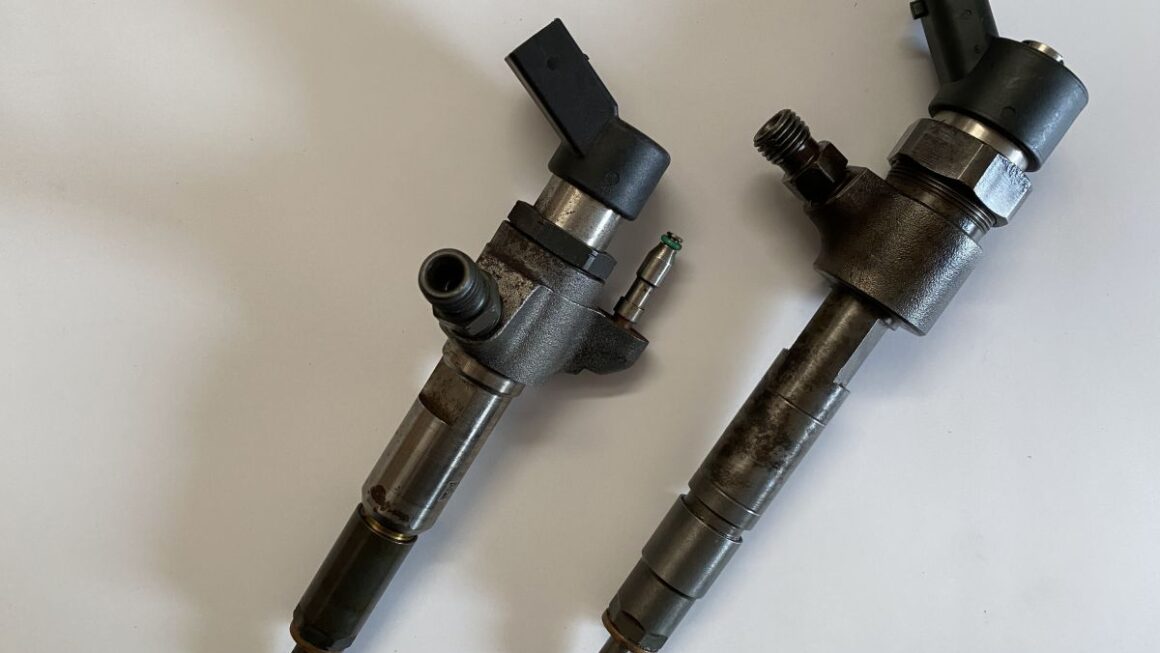
A piezo stack. Instead of a coil there is a stack of crystals that change dimension under voltage. It switches many times faster than a coil, so the ECU can split one injection into several doses within a single stroke. The result is quieter running and lower emissions, but also a more expensive and more delicate part. We go into the principle itself in the article on piezo injectors.
Axis three: where the pressure comes from
An injection pump, inline or distributor type. The older diesel solution. The pump both generates pressure and meters the dose, and the pressure depends on engine speed. Simple and durable, but with no way to shape the injection event precisely.
Common rail. A separate pump holds high pressure in a rail shared by all cylinders, and the ECU only decides when and for how long to open a given injector. The key advantage is that pressure no longer depends on engine speed, so the engine can run civilly low down as well.
The unit injector. Pump and injector in one body, driven by the camshaft, one per cylinder. Used in a number of diesels around the turn of the century. It produces very high pressure, but injection timing is tied to the cam lobe, so there is less freedom in control than with common rail.
What this means for the owner
| what you have | typical failure | cleaning | reconditioning |
|---|---|---|---|
| petrol, port injection | gummed nozzle, hardened o-ring | additive works well, ultrasonic is cheap | rarely worth it, cheaper to replace |
| petrol, direct injection | carbon on the tip, leakage | additive helps the injector, not the valves | possible, more expensive |
| diesel, injection pump | worn nozzle, dropped opening pressure | ultrasonic, often just a new nozzle | yes, cheaply and with no coding |
| diesel, solenoid common rail | excessive back-leak, worn control valve | additive, service cleaning, ultrasonic | yes, but codes must be written |
| diesel, piezo common rail | fatigued stack, no parts available | as above | often impossible, replacement only |
| diesel, unit injector | nozzle wear, leaks past the seals | limited, mainly after removal | yes, with adjustment on fitting |
One practical conclusion follows from that table. Before you start ringing round for prices, establish which design your car uses, because the gap between reconditioning a nozzle in an old diesel and replacing a set of piezo units is an order of magnitude. We have set out the cleaning methods and their limits in the article on what to clean injectors with, and the workshop repair itself in the article on reconditioning.
An LPG car, the special case
A car running on gas has two sets of injectors working at once. The gas ones, plumbed into the intake manifold, and the original petrol ones, which sit idle most of the time.
Those idle ones are exactly where trouble starts. A petrol injector with nothing flowing through it for months can gum up on fuel residue, and the owner finds out only when the gas system fails, the car has to run on petrol and suddenly runs rough. So in an LPG car it is worth covering a few dozen kilometres on petrol every so often, if only to flush through the set that normally rests.
A fuel additive in such a car only works while the engine is actually running on that fuel. Pouring it into the tank and carrying on driving on gas achieves nothing.
How to work out what you have
The simplest route is the registration document and the engine code, then a parts catalogue. A few abbreviations in the version name usually settle it: badges such as CDI, HDi, TDCi, JTD and dCi mean common rail diesels, PD points to unit injectors, and FSI, TSI, GDI and THP mean direct injection petrol.
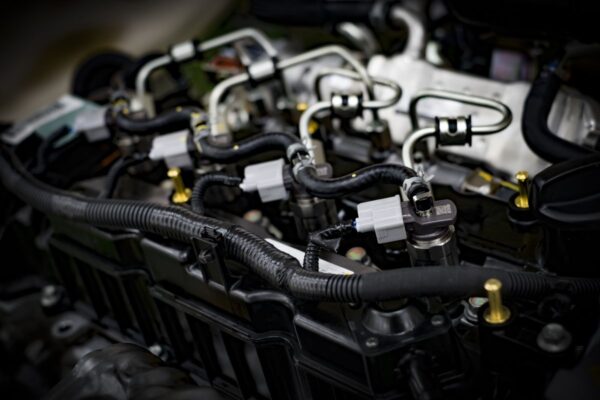
The second method is simpler still: look under the cover. If the injectors sit in the intake manifold, you have port injection. If they enter the head and a thick metal pipe runs to each from a shared rail, that is common rail.
There is one more reason to know this in advance. In high mileage diesels an injector can seize in its bore in the head, and then a straightforward removal turns into serious work. It is worth knowing that before the workshop starts turning, and we describe the scenario in the article on a seized injector.