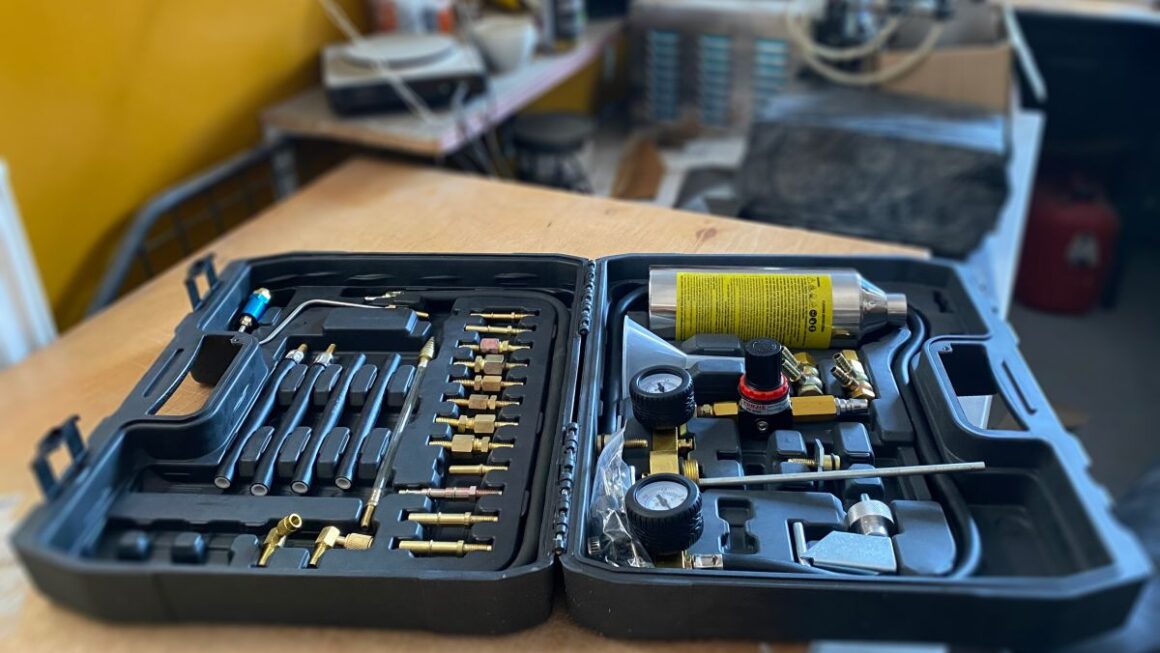
Before choosing a method it helps to know where the deposits actually sit. An injector gets dirty from two directions at once, and most cleaning methods only reach one of them. This article says plainly what each method removes, what it cannot touch, and what you must never do to an injector.
Where the deposits actually sit
An injector collects grime from two directions, and they are completely different substances.
On the fuel side, in the channel, on the needle and in the spray holes, lacquer forms. It comes from fuel oxidation products, and high temperatures and long stands with a full tank accelerate it. This deposit dissolves in fuel, provided the right detergent is in that fuel.
On the combustion side, on the nozzle tip protruding into the cylinder, a hard carbon crust builds up. No fuel flows across it, so a detergent poured into the tank barely touches it. That crust distorts the spray pattern and can partly close the holes from outside.
This distinction explains why some people swear by fuel additives while others say they do nothing. Both are right, they are simply talking about two different deposits.
Methods and what each actually reaches
| method | what it removes | what it cannot touch | removal needed |
|---|---|---|---|
| tank additive | lacquer in the channel, on the needle, in the holes | combustion side carbon, wear | no |
| on-car service cleaning | the same, but stronger and in one session | combustion side carbon, wear | no |
| ultrasonic bath | deposits on both sides, including the tip crust | changed geometry | yes |
| test bench with flushing | as above, plus a measured printout | changed geometry | yes |
| replacement | everything | nothing, it is a new part | yes |
The tank additive, the cheapest way in
Detergent travels with the fuel and works wherever the fuel goes. The advantage is no disassembly at all and a cost in the region of one fill-up. The drawback is that it works slowly, across a whole tank, and performs no miracles on advanced carbon.
TEC 2000 offers two different products here and they suit different situations, so it is worth not mixing them up. System Cleaner is the stronger one, goes into the tank and works through the entire tankful. Injector Cleaner is gentler and intended for workshop use. Both come as separate diesel and petrol versions. The versions are not interchangeable, because the detergent packages are matched to a different fuel and a different kind of deposit.
The sensible moment for an additive is prevention, or the first mild symptoms. If the engine already runs visibly rough or smokes, chemistry in the tank is too weak a tool and not worth the wait.
Service cleaning without removal
The workshop isolates the tank supply and feeds concentrate from a canister into the system, then runs the engine on it for anything from fifteen minutes to an hour. The concentration is incomparably higher than an additive diluted in a full tank, so the effect arrives immediately instead of a week later.
It is a good middle option: none of the risk that comes with unscrewing injectors, and clearly more effective than a plain additive. The limit is unchanged, because the fluid still circulates only on the fuel side and never reaches the crust inside the cylinder.
Ultrasonic cleaning, the method that needs removal
Removed injectors go into a bath where an ultrasonic wave causes cavitation. Microscopic bubbles collapse against the metal and lift deposits from every surface the liquid reaches. Of the methods listed, this is the only one that deals with the crust on the nozzle tip.
It has two catches. The first is the removal itself, because an injector in a high mileage diesel can seize in its bore, and then a separate story begins, which we cover in the article on a seized injector. The second is that clean does not mean healthy. A bath will not rebuild an eroded needle seat. That is why it is worth insisting on a bench measurement after cleaning, and we go into that in the article on injector reconditioning.
What you must never do to an injector
Two pieces of forum advice are simply harmful.
Washing them in soapy water. The deposits in question sit in the fuel channel and in holes measured in hundredths of a millimetre. Soapy water has nothing to achieve there and plenty to ruin: it leaves moisture in the channel, gets into the electrical connector and encourages corrosion on surfaces that must stay perfectly smooth. An injector is not washed like a lawnmower part.
Scraping the nozzle. Spray holes are machined to micron tolerances and their job is to release a spray of a specific shape. Touching the edge of a hole with a wire or a scraper is enough to alter the delivered dose permanently. That is not cleaning, it is damage no workshop can undo.
If the crust on the tip is so hard that scraping it feels tempting, the right answer is an ultrasonic bath, not a tool.
Direct injection petrol, the exception nobody mentions
In a port injection engine, fuel sprays onto the intake valves and washes them in passing, so detergent from the tank genuinely reaches them. In a direct injection engine, fuel goes straight into the cylinder and never touches the valves at all.
The conclusion is inconvenient but has to be said: no additive poured into the tank will clean coked intake valves on a direct injection engine, because there is no route for it to get there. That job needs mechanical cleaning with a blasting medium after the manifold comes off. The additive looks after the injectors themselves, and does that well, but valve carbon is a separate problem and a separate bill.
How often to do it
The popular “once a year” rests on nothing. No car manufacturer recommends it and it follows from nothing but habit.
It makes more sense to think in conditions than in calendar dates. A preventive additive earns its place where deposits grow faster: mostly short trips, filling up at whichever station happens to be nearest, high mileage on fuel with a high biocomponent content. If the car covers long distances and always fuels at the same stations, you can reach for chemistry less often.
The most important point, though, concerns order rather than frequency. Before spending money on cleaning, it is worth knowing whether the problem is deposits or wear, because the symptoms are identical and only measurement settles it. It also helps to establish which injector type your car uses, since the design decides which methods are even on the table, and we have gathered that in the article on types of injectors.