TEC 2000 vs Bardahl: which engine flush is better?
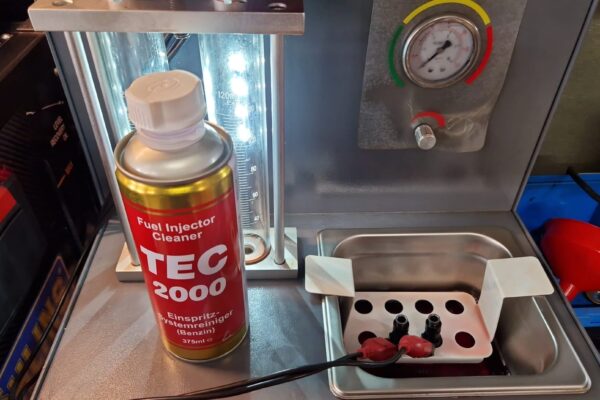
Short answer: Bardahl sells two flushes and people mix them up constantly. One is Engine Flush (ref. 1032, 300 ml). It’s a solvent flush, and its safety data sheet lists kerosene (1-10%) with no separate anti-wear additive. The other, Engine Tune-Up & Flush (4019), does have one. TEC 2000 Engine Flush goes another way: a solvent blend on an aromatic base, chlorine-free and kerosene-free, with two anti-wear agents named in its safety data sheet - a sulfurized olefin and ZDDP - both there to hold up the oil film while the flush does its work.
Below we take it apart properly: what the official safety data sheets actually say, how Bardahl’s two products differ, how you use each one, and what you pay. The yardstick throughout is what the maker documents and what independent sources show. Not what the bottle promises.
Who this guide is for
You’re standing over the engine before an oil change, weighing the Bardahl name - the one you know from motorsport - against TEC 2000. That’s who this is for. Most comparisons online just parrot the shop blurb. This one puts both brands on their safety data sheets (SDS): what’s actually in the tin, how it works on the oil system, and whether the formula earns the price.
First: Bardahl is two different products, not one
Clear this up first. Two Bardahl products carry almost the same name, and they get muddled all the time online. Different size, different formula, different way of running them.
- Bardahl Engine Flush (ref. 1032 / 1032B, 300 ml) - the classic solvent flush you pour in just before you drain the oil. Its SDS lists a C10-C13 hydrocarbon base plus kerosene. This is the one that usually shows up on the European market.
- Bardahl Engine Tune-Up & Flush (ref. 4018 / 4019, 355 ml) - the manufacturer calls it “a concentrated blend of solvents, dispersants, detergents and anti-wear additives,” and it’s meant to work over a longer stretch (one of the stated methods is driving 100-200 miles / ~160-320 km). Different product, richer, and it costs more.
For the rest of this article we put TEC 2000 up against Bardahl Engine Flush (1032). It’s the fair match - both are oil flushes you use right before draining. Where the pricier Tune-Up & Flush changes the picture, we’ll say so.
Composition and safety - what the data sheets say
This is the part that matters. What’s in the blend decides how hard it works on deposits, and how it treats your seals. So we go by the official safety data sheets (SDS), not the shop listing.
Bardahl Engine Flush (1032)
The SDS for the version sold across European markets (DE/NL/FR/ES/DK, art. 1032) gives the composition as:
- (2-methoxymethylethoxy)propanol (DPM) - a glycol-ether co-solvent, 1-10%.
The sheet lists no separate anti-wear additive - no ZDDP. Bardahl’s marketing talks up “excellent lubricating properties,” but the safety document itemises no distinct lubricant. Whatever lubricity is there comes from the hydrocarbon base itself.
For completeness: the Italian Engine Tune-Up & Flush (cod. 147023) has kerosene as its dominant ingredient (≥80%), and the US version (#4019) sits on ≥80% petroleum distillates under a stricter local classification. Different SKUs, different markets. For a European driver the reference point stays the Bardahl Engine Flush 1032.
TEC 2000 Engine Flush
A solvent blend on an aromatic base, chlorine-free and kerosene-free. Here’s the part that counts. The safety data sheet doesn’t stop at the solvent - it names two anti-wear agents, a sulfurized olefin and ZDDP (CAS 6990-43-8), and that pair is what holds up the oil film while the flush runs. TEC 2000 also declares the blend safe for Nikasil coatings and rubber seals. It was one of the first flushes to drop chlorinated hydrocarbons.
Straight from the sheet: both of those agents are itemised, so the oil-film protection is on paper, not a line off the label. That’s the real split against Bardahl Engine Flush 1032, whose sheet shows no separate anti-wear additive at all. We’re not reading anything into the Bardahl document that isn’t there, and we’re not guessing at the TEC 2000 one either. The full component breakdown for both sits in our engine-flush safety data sheets database.
Kerosene in a flush - is it actually a problem?
Let’s take the heat out of this one. Kerosene has been a cleaning solvent in the motor trade for decades. On its own it isn’t “poison” to an engine - it dissolves deposits, and it does the job well. In Bardahl Engine Flush it sits at a small share (1-10%) and backs up the C10-C13 base. “Kerosene will wreck your engine” is about as much a myth as “our flush cleans the engine by itself.”
The real difference is quieter. It’s about lubricity during those 15-30 minutes the engine runs on thinned-out oil. Independent lubrication people are careful here. Machinery Lubrication files chemical solvent flushes under “last-resort” and warns that aggressive solvents can “retard the performance of… anti-wear agents.” A flush that carries its own anti-wear chemistry should hold the sliding pairs better in that short window, and TEC 2000’s sheet lists two agents for exactly that job (the sulfurized olefin and ZDDP), where Bardahl Engine Flush 1032’s lists none. One honest caveat: that’s reasoning from the chemistry, not a bench test running the two head to head. Take it as mechanism, not a lab result.
Why an anti-wear additive matters
A pure solvent thins the oil and weakens the film. Run the engine on thinned oil, even at idle, and the camshaft, the bearings and the cam-follower pair all sit at raised risk for those few minutes. That’s why the engineering on flushing fluids wants a flush to carry something that props up lubricity. Bardahl Engine Flush (1032) itemises nothing of the sort in its sheet. The pricier Tune-Up & Flush (4019) declares one as a formulation ingredient. TEC 2000 lists two, the sulfurized olefin and ZDDP. For more on what actually does the lubricating inside a flush, see our engine-flush composition analysis.
Oil-flush comparison table
The table lines TEC 2000 up next to Bardahl and the other popular oil flushes. The numbers come from safety data sheets and manufacturer materials.
| Brand | Product | Base / strength | Lubricant buffer (SDS) | Kerosene | Key feature | Verdict |
|---|---|---|---|---|---|---|
| LIQUI MOLY | Pro-Line Engine Flush | Mixed · Strong | ZDDP 1-2.5%, no EP additive | No - hydrocarbons C10-C13, under 2% aromatics (70-90%) + paraffinic fractions | Dearomatised C10-C13 base with ZDDP at 1-2.5% and calcium sulfonate at 1-2.5% (Section 3). The regular Engine Flush 2640 has the same declared composition as Pro-Line | Effective premium solvent; the sheet lists ZDDP protecting surfaces during the flush |
| Wynn's | Motor Cleaner - Oil System Cleaner 325 ml | Mixed · Medium | None in the SDS | Heavy petroleum distillates (≥50%) + C10 aromatic hydrocarbons 10-15% | Kerosene base with C10 aromatics and amine; notably higher aromatic content than premium brands | Strong dissolving action from aromatics, but kerosene base with diethanolamine raises questions about compatibility with modern seals |
| Bardahl | Engine Flush / Pre-Drain Cleaner 300 ml | Kerosene/heavy · Strong | None in the SDS | Hydrocarbons C10-C13 (80-95%) + kerosene 1-10% | C10-C13 solvent dominant; kerosene addition boosts dissolving power, no lubricant additive | Solid solvent formula with kerosene addition; absence of lubricant means no seal protection during the flush cycle |
| MANNOL | Motor Flush 9900 | Mixed · Medium | Calcium sulfonate (detergent), no ZDDP | Mineral oil base; only disclosed hazardous ingredient is ethoxylated isotridecanol (<0.5%) | Very sparse SDS - mineral oil base with calcium sulfonate, limited composition data | Budget option with limited SDS data; difficult to assess full composition without complete safety sheet |
| Moje Auto | MA Professional Engine Flush 400 ml | Heavy synthetic (GTL) · Gentle | None in the SDS | No - synthetic GTL Fischer-Tropsch base (heavy distillates C18-C50) 75-85% | The only declared component is a GTL synthetic (Fischer-Tropsch, CAS 848301-69-9) at 75-85%; the sheet lists no lubricant additive or detergent and does not declare the remainder | Budget flush on a heavy C18-C50 synthetic base, gentle on seals (the sheet lists H304 only). A heavy fraction dissolves less than light solvents, and the sheet declares no lubricant additive |
| TEC 2000 ⭐ BEST PICK | Engine Flush | Aromatic · Very strong | ZDDP + sulphurised olefin (EP) | No | Advanced hydrocarbon solvent blend (aromatic base) + additive package with ZDDP (anti-wear, CAS 6990-43-8, listed in SDS v3.1); chlorine-free, no kerosene | Top pick - effective and seal-safe |
| Motul | Engine Clean Auto | Aromatic · Medium | None in the SDS | Hydrocarbons C10-C13, <2% aromatics (50-100%) + light paraffinic distillate (10-25%) | Pure C10-C13 solvent base; no ZDDP or other lubricant additives | Proven solvent from a premium brand, but purely solvent-based - TEC 2000 additionally offers a lubricant component protecting seals |
| K2 | Motor Flush T371 250 ml | Aromatic · Very strong | None in the SDS | Reaction mass of ethylbenzene and xylenes (<70%); aromatic hydrocarbons | Aromatic base (ethylbenzene + xylenes) - powerful solvent, classified as flammable and harmful by inhalation | High-activity aromatic formula effectively removes deposits, but xylenes carry higher OHS risk than the light C10-C13 alkanes used by premium competitors |
| Mathy | MATHY-C Motor Interior Cleaner (Engine Flush) 400 ml | Mixed · Medium | ZDDP 1-3%, no EP additive | Hydrocarbons C12-C15, <2% aromatics (50-100%) + sodium petroleum sulfonate (5-10%) | Unique 3-component formula: C12-C15 solvent + sulfonate detergent + ZDDP (1-3%) | One of the few competitors with a ZDDP component; similar approach to TEC 2000 (solvent + lubricant balance), though with a different type of lubricant additive |
| STP | Engine Flush 30-011 450 ml | Mixed · Strong | ZDDP 1-3%, no EP additive | Hydrocarbons C11-C14, <2% aromatics (50-100%) + heavy paraffinic distillate (10-25%) | C11-C14 solvent with paraffinic base oil and ZDDP (1-3%) - three component classes | Competent formula with ZDDP providing anti-wear protection; similar philosophy to TEC 2000, but solvent base dominates |
| Castrol | Engine Shampoo (Castrol Flush) 300 ml | Light aliphatic · Gentle | Molybdenum dithiocarbamate (friction modifier) | Hydrotreated heavy paraffinic distillate (≥75-90%); light solvents as minor fractions (≤3%) | Exceptionally oil-heavy base (≥75% heavy distillate) + trace molybdenum dithiocarbamate friction modifier | Gentle paraffinic oil-based formula - minimal seal risk, but limited dissolving power; TEC 2000 achieves solvent+lubricant balance without such a dominant oil base |
| Comma | Engine Flush (Petrol/Diesel) 400 ml | Mixed · Medium | ZDDP under 1%, no EP additive | Hydrotreated heavy paraffinic distillate (15-25%) as main disclosed ingredient; full composition not revealed in SDS | Limited SDS data; declared ZDDP (<1%) and alkyl phenol (<1%) as additives | Insufficient SDS data makes full assessment difficult; ZDDP presence is positive, but low concentration and lack of composition transparency |
| Forté | New Generation Motor Flush 400 ml | Aromatic · Strong | None in the SDS | Hydrocarbons C10-C13 with aromatics 2-25% (≥50%) + C10 aromatics (10-25%) + glycol ether DPM (10-25%) | 3-solvent formula with notable C10 aromatic and DPM glycol ether content; no lubricant additive | Aggressive solvent formula (aromatics + glycol) effectively breaks down varnish and sludge; no lubricant component - seals unprotected during flush |
Comparison data is being expanded and verified from manufacturer sources.
How to use them - step by step
You use both brands more or less the same way - pour the flush into the old oil before you drain it. Where they part company is the stated run time, and that part matters.
- Warm the engine to operating temperature, then drop it to idle.
- Pour in the flush. Bardahl Engine Flush: 300 ml into up to about 4.5 l of oil. TEC 2000: one dose per 4-5 l of oil, per the maker.
- Let it idle. Here’s the split - Bardahl’s instructions say about 30 minutes at idle, or up to ~50 km of driving instead. TEC 2000 asks for roughly 10-15 minutes at idle. The longer the engine runs with flush in the oil, and the harder you work it, the more that lubricity question counts.
- Drain the old oil and the flush together, change the oil filter, fill with fresh oil.
What we’d tell you: with any solvent flush, keep to the shorter idle cycle and don’t load the engine. The “drive up to 50 km” option is for a sound, well-kept engine only, and it’s on you. If the engine is high-mileage and caked with deposits, start with our guide on whether an engine flush can cause leaks.
Price and availability
This one’s murkier than it is with the cheap brands. Bardahl Engine Flush (300 ml) goes for around €25 in Europe (about £15 in the UK), not a budget flush, an upper-shelf one. In some markets, Poland among them, you barely see Bardahl Engine Flush on the shelf. Those shelves belong to Liqui Moly, TEC 2000, Pro-Tec and Valvoline, and we couldn’t pin down reliable local retail prices for Bardahl. TEC 2000 Engine Flush is a premium product too, but it’s a lot easier to actually buy.
So price isn’t what settles this one; both sit on the upper shelf. What settles it is the formula (a confirmed anti-wear pair versus kerosene), what you can get locally, and which brand you trust. For the fuller cost picture, see our ranking of the best engine flushes.
What no engine flush will do
Time to knock down a few myths, marketing ones included. No flush “removes all deposits in 10 minutes,” and none “reverses” engine wear. Hard, coked deposits are bonded to the metal. Detergents don’t dissolve that - at best they loosen it and hold it in the oil so it drains out with everything else. Oil and flush suspend the muck; they don’t scrub the engine on their own. How that coking builds up in the first place is in our piece on engine oil coking.
So take a claim like “excellent lubricating properties” (Bardahl) or “safe for every engine” (anyone) with a cold eye. Go and check whether a named ingredient in the sheet backs it up, or whether it’s just words. That’s exactly where these two split: Bardahl Engine Flush 1032’s sheet describes a solvent system with no itemised anti-wear agent, while TEC 2000’s names two of them (a sulfurized olefin and ZDDP). Same test applied to both, and they don’t come out the same.
Verdict: Bardahl or TEC 2000?
Go with Bardahl Engine Flush if you trust the brand, you can get it locally, and you want a strong, proven solvent base for a one-off flush on a healthy engine. Just remember the longer 30-minute cycle, and don’t load the engine.
Go with TEC 2000 Engine Flush if you want oil-film protection while the flush works, and here it’s on paper rather than on the label: the safety data sheet names two anti-wear agents, the sulfurized olefin and ZDDP. Add a base with no kerosene and no chlorine, declared seal safety, and the fact that you can actually find it across most European markets. For someone who cares what happens inside the engine during those minutes, it’s the tidier pick.
One thing worth flagging: unlike the TEC 2000 vs K2 match-up, where neither side ran kerosene, here the kerosene-versus-no-kerosene split is real and written into Bardahl’s data sheet. The anti-wear side goes the same way. TEC 2000’s sheet lists two agents (the sulfurized olefin and ZDDP); Bardahl Engine Flush 1032’s lists none. To see how TEC 2000 stacks up against another premium solvent brand, read our TEC 2000 vs Liqui Moly comparison, and for the full component breakdown see the engine-flush safety data sheets.
FAQ
Does Bardahl Engine Flush contain kerosene?
Yes. The safety data sheets for the European Bardahl Engine Flush (ref. 1032) list kerosene (CAS 8008-20-6) at 1-10%, next to the main C10-C13 hydrocarbon base. TEC 2000 Engine Flush is kerosene-free, so on this point the two genuinely differ.
What’s the difference between Bardahl Engine Flush and Engine Tune-Up & Flush?
They are two different products. Engine Flush (1032, 300 ml) is a solvent “pre-drain” flush with no declared anti-wear additive. Engine Tune-Up & Flush (4019, 355 ml) is described by the manufacturer as a blend of solvents, detergents and anti-wear additives, designed for a longer window (driving 100-200 miles is one method). They differ in volume, composition and run time.
How long do you run Bardahl flush in the engine?
Bardahl Engine Flush instructions state about 30 minutes at idle, or alternatively driving a maximum of ~50 km, after which you drain the oil and change the filter. For comparison, TEC 2000 recommends a shorter, roughly 10-15-minute idle cycle. With any flush, don’t load the engine.
Is Bardahl safe for seals?
Used per instructions (briefly, before an oil change), it is a typical solvent flush. The key is not exceeding the time and not driving under load. TEC 2000 additionally declares safety for rubber seals and the absence of sulphur. On a high-mileage engine with suspected worn seals, be cautious with any aggressive solvent flush.
Bardahl or TEC 2000 - which is better?
On a healthy engine for one-off use, both work as a solvent flush. If you want oil-film protection during the flush (an anti-wear component), a kerosene-free base and easy availability, TEC 2000 is the better pick. Neither product will “repair” an engine or reverse wear.
Does a solvent flush reduce oil lubricity?
During the flush - yes, the solvent thins the oil and weakens the film. That is why it matters whether the product carries its own lubricity-boosting component (TEC 2000’s safety data sheet lists an anti-wear additive, ZDDP), and why you should not load the engine or exceed the recommended run time.
Sources
- Bardahl Engine Flush safety data sheets (art. 1032/1032B), DE/NL/FR/ES/DK market versions, 2018-2024 - Bardahl.
- Bardahl - official product pages for Engine Flush and Engine Tune-Up & Flush (bardahl.com, english.bardahl.fr).
- TEC 2000 - product page and composition materials (tec2000.pl).
- Machinery Lubrication - “Selecting the Best Strategies for a Successful Oil Flush.”