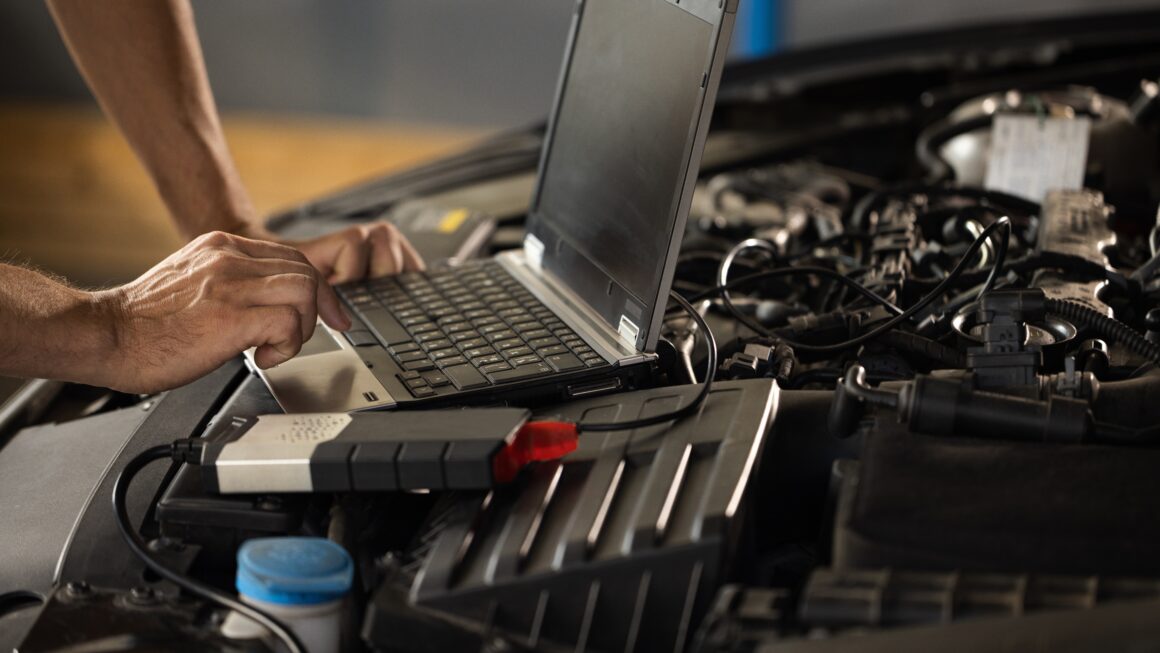
A negative injector quantity correction is when the engine control unit (ECU) subtracts fuel from one common-rail injector because it is delivering too much compared with the others. A positive correction is the reverse - the ECU adds fuel to an injector that is delivering too little. It is a per-cylinder balancing value, measured in mg/stroke, and should not be confused with the global fuel trim that a lambda sensor controls.
Injector correction vs fuel trim (negative fuel trim) - what’s the difference?
These are two different mechanisms, even though both run at once on a diesel. If you came here searching for negative fuel trim, that is the global one: fuel trim (LTFT/STFT) is calculated from the lambda sensor for the whole bank of cylinders and expressed as a percentage of deviation from a baseline. Injector quantity correction is per-cylinder - the ECU balances the fuel delivered to each injector individually, in milligrams per stroke, and it does not read exhaust composition to do it. It reads how smoothly the engine runs: tiny fluctuations in crankshaft speed, often called smooth running.
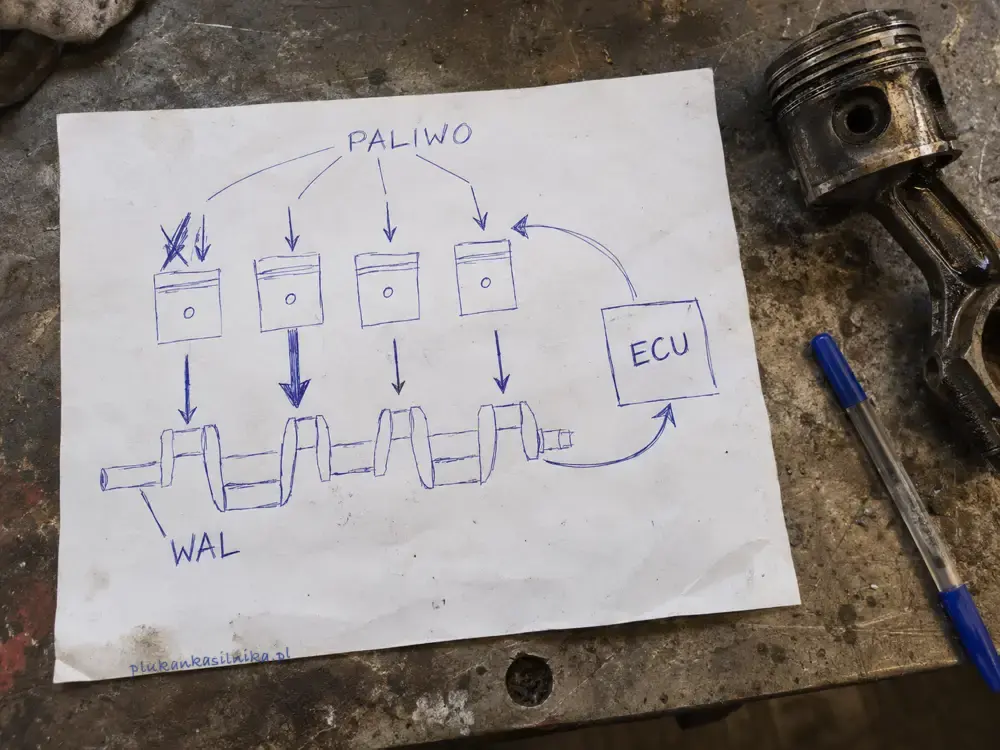
The mechanism is simple. Between power strokes the ECU measures how hard each cylinder pushes the crank along. A cylinder that accelerates the crank too strongly gets fuel taken away (a negative correction); one that pushes too weakly gets fuel added (positive). Bosch documentation calls this Mengenausgleichsregelung - quantity balancing control. That is why a common-rail scan shows a separate value for every injector rather than one number for the whole engine.
A common mistake, repeated in plenty of guides, is to blur the two into one. Someone asking about “acceptable injector corrections on a 1.6 TDI” is asking about the per-cylinder mechanism but often gets handed a description of lambda-based fuel trim instead. They are two different diagnoses and two different repairs.
| Feature | Fuel trim (LTFT/STFT) | Injector quantity correction (per-cylinder) |
|---|---|---|
| Scope | global - whole bank / engine | per-cylinder - each injector separately |
| Control signal | lambda sensor (exhaust composition) | smooth running = crankshaft speed fluctuations, not lambda |
| Engine type | mainly petrol; on diesel also global via lambda and air | common-rail diesel (Mengenausgleichsregelung) |
| Unit | % (deviation from baseline) | mg/stroke (delivery per injection) |
| Where you see it | fuel trim PID, codes P0170-P0175 | measuring block in the diagnostic software; cylinder-to-cylinder spread at idle |
A common-rail diesel runs both systems at once: the global correction from lambda and the per-cylinder correction from smooth running.
What does a negative or positive injector correction mean?
The sign tells you which way the ECU has to “trim” a given injector so its cylinder pulls its weight with the rest. Negative means the ECU is subtracting fuel - that cylinder is delivering too much, or pushing the crank too hard. Positive means the ECU is adding fuel - the cylinder is delivering too little, or pushing too weakly.
The number on its own is not a verdict. What matters is how far the injectors drift from one another. An engine where all four corrections sit close to zero and look similar runs smoothly. An engine where one injector shows a big positive and its neighbour a big negative will run rough, even if the corrections theoretically “cancel out” on paper.
An important trap: negative does not mean “the healthier injector” and positive does not mean “the worse one”. Both signs are just the ECU reacting to a deviation - the problem is a large deviation, whichever direction it points.
How do you read injector correction values on a scan tool?
Corrections are read from a measuring block in the diagnostic software, and only under the right conditions - otherwise the numbers mean nothing. The unit is mg/stroke. The measuring group number depends on the ECU (on VAG engines in VCDS it tends to be one of the smooth-running blocks), so treat any specific block number with caution and confirm it for your own ECU.
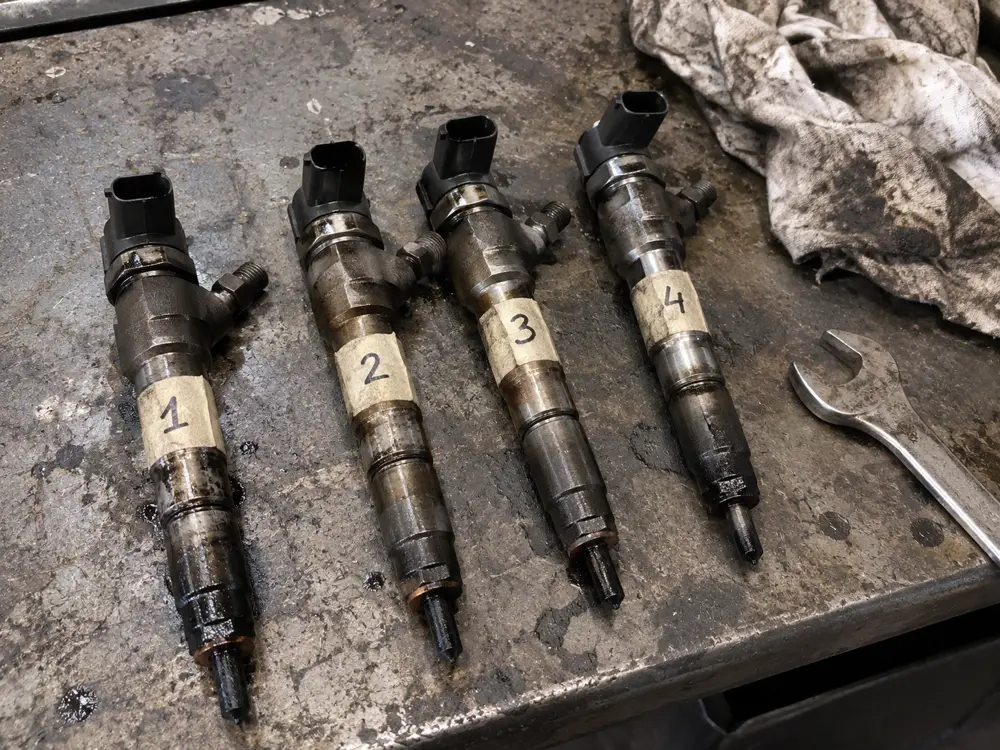
The conditions without which the reading is worthless: engine at operating temperature, stable idle, and consumers switched off (air conditioning, lights, cooling fan). What counts is the spread between cylinders, not the absolute value of any single injector.
The classic way to confirm the guilty injector is to swap it. Move the suspect injector to a different cylinder and watch whether the correction “follows” it. If the high correction travelled with the injector, the injector is at fault. If it stayed on the same cylinder, look at compression or valves, not the injector. There is more on the measuring procedure itself in the guide on how to check common rail injectors.
What are the acceptable and limit correction values?
There is no single universal figure - the threshold depends on the platform and manufacturer, and it is given by the service documentation and the diagnostic software for the specific ECU. Workshops use roughly ±2 mg/stroke as a normal figure and around ±4 mg/stroke as an alarm limit - but these are working shop numbers, not OE figures for a specific engine. That is why I deliberately won’t pin a threshold to a 1.6 TDI, an HDI or any other badge: anyone who says “for a 1.6 TDI exactly this much is allowed” is usually repeating someone else’s number with no OE source behind it. Treat the ranges above as a rough orientation and read the hard threshold from the software for your own ECU.
And one thing the diagnosticians themselves keep repeating: a single +2 mg/stroke on its own does not mean a failed injector. You need context - the spread relative to the others, the vehicle’s history, the presence of fault codes. A number without context is not yet a diagnosis.
| Reading | Interpretation | Likely cause | Action |
|---|---|---|---|
| All close to zero, small spread | Normal | - | Monitor |
| One injector heavily negative | ECU subtracting - injector delivers too much | leaking / over-delivering injector, or a compression deviation | back-leak test, swap between cylinders |
| One injector heavily positive | ECU adding - injector delivers too little | deposits (reversible) or mechanical wear (irreversible) | clean first / PEA detergent; if it persists - recondition |
| Large spread right after replacement or reconditioning | artificial spread | missing or wrong IMA / IQA / ISA code | write the correct code to the right cylinder |
What does an IMA, IQA or ISA code on an injector mean?
It is the individual calibration code for that specific injector, which the ECU uses to match its fuelling to the injector’s real characteristic. Every injector leaves production with small tolerances; the manufacturer measures them on a test bench and stores the result as a code. Knowing the code, the ECU trims the drive signal to that particular unit - before the per-cylinder balancing on a running engine even begins.
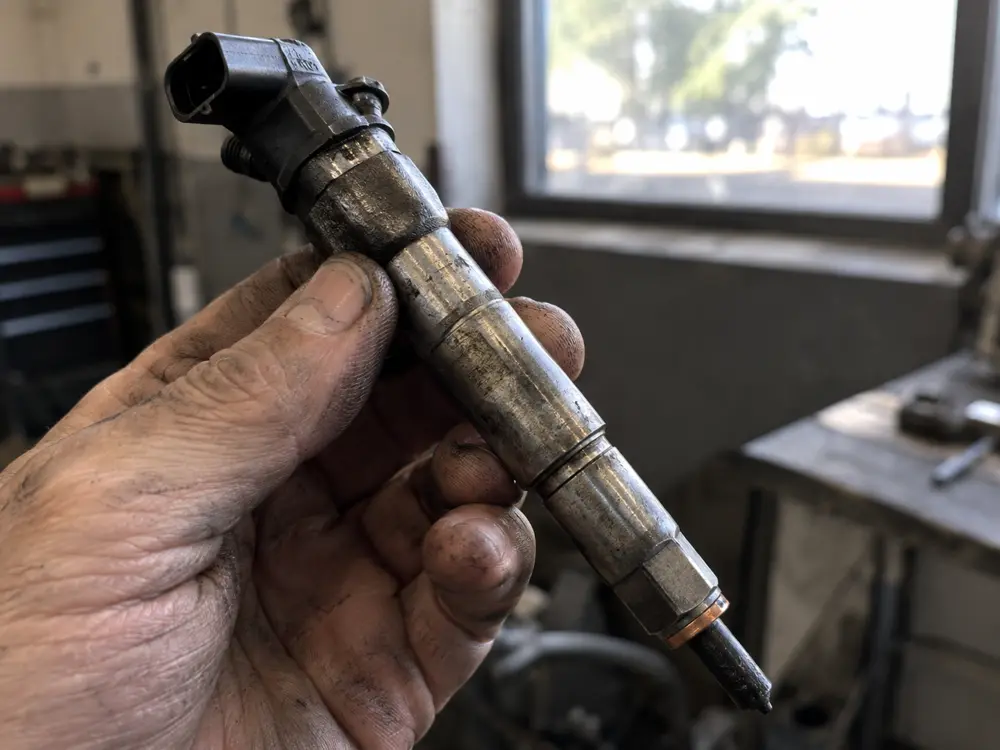
The naming depends on the injector manufacturer. Bosch uses IMA / IQA / ISA (IMA is Injektor-Mengen-Abgleich, meaning injector quantity balancing; IQA is Injector Quantity Adjustment). Delphi uses C2i / C3i / C4i, Siemens/VDO uses IIC, and Denso uses a QR code. On a Bosch injector the IQA code is a 7-character string that contains no letters J or Q and no digits 0 or 9. You will find it laser-etched on the injector body, on a label, or in the test-bench report.
Why it matters: the code has to be written into the ECU after every replacement or reconditioning, assigned to the correct cylinder (on VAG cars through the injector coding function in VCDS or ODIS). Hence a practical conclusion: a high correction right after replacement or reconditioning does not always mean a bad injector. If the code was never entered, or entered wrongly, the ECU guesses the characteristic and creates an artificial spread - with rough running, smoke and a power drop. Bosch piezo injectors sometimes won’t even fire without the correct code. Before you write off a new injector as faulty, check that the code is where it should be.
Why do corrections drift apart? Deposits vs mechanical wear
A drift in corrections has two completely different causes that have to be kept firmly apart, because they lead to two different repair paths. The first is deposits - reversible. The second is mechanical wear - irreversible.
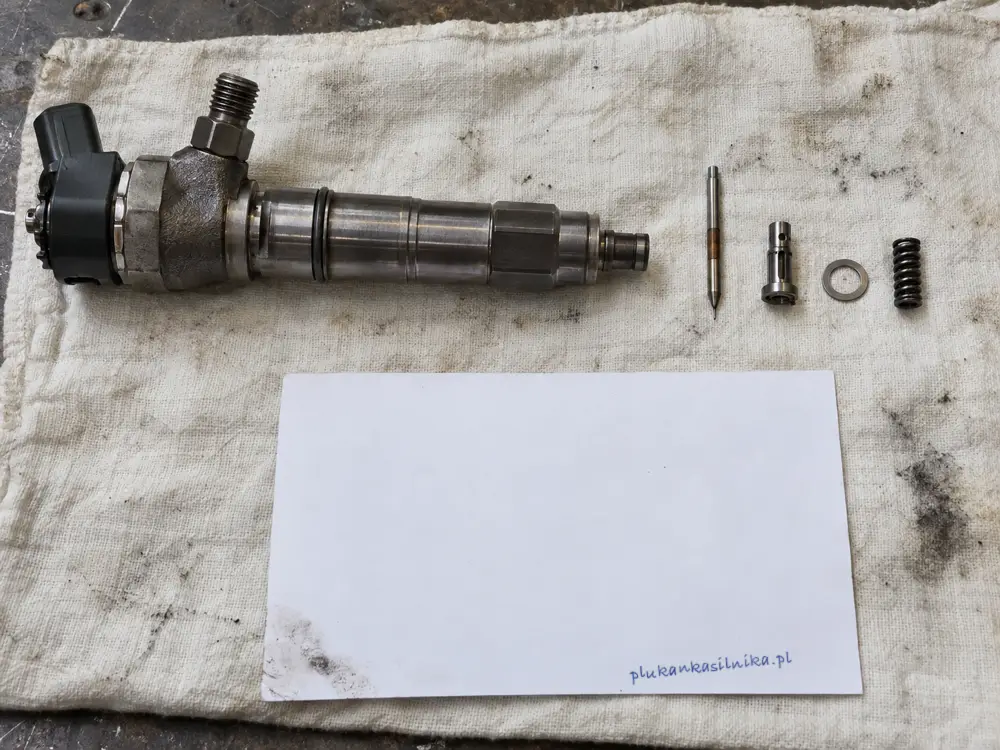
Internal diesel injector deposits (IDID in the literature) are nanometre-scale films on the precision surfaces that disturb the movement of the needle. They change the amount and timing of injection, so the ECU has to compensate with a correction. Since the deposit can be removed, the correction returns to normal once the injector is cleaned. IDID is studied by independent research bodies, among them the Southwest Research Institute - this is a documented mechanism, not workshop folklore.
Mechanical wear is a different story: a worn nozzle tip, a cracked body, a tired piezo element. No detergent “rebuilds” any of that - the only route here is reconditioning or replacement. When an injector has crossed the line into needing reconditioning, versus when it is still worth cleaning, is broken down in the guide on injector reconditioning, with a cost comparison between reconditioning and replacement.
The practical tell: if the correction climbs gradually and touches several injectors at once, deposits and fuel quality are usually behind it. If one injector has bolted off sharply and does not respond to cleaning, think mechanical damage.
What do corrections look like on common engines like the 1.6 TDI or HDI?
Whether it is a 1.6 TDI from the VAG group, a PSA HDI, or any other modern high-pressure common-rail diesel, the principle is the same across all of them: the ECU balances fuelling per cylinder according to smooth running and shows it in mg/stroke. All that differs is how the code is written and the measuring-block number - and those belong to the ECU family, not to the “engine” in the everyday sense, so check them for your own controller. The method stays the same: warm the engine, stabilise the idle, read the spread, and if you suspect one injector, swap it to another cylinder.
How do you spot drifted corrections in day-to-day driving?
The symptoms overlap with the usual picture of worn or contaminated injectors, because a drift in corrections is their electronic measure. Most often it is hard cold starting, rough idle, and hesitation in roughly the 1600-2200 rpm range. On top of that come black or white smoke, a rise in fuel consumption of around 1-3 l/100 km, cold-start knock, and in worse cases fuel in the oil and a loss of power above 3000 rpm.

In diagnostics, drifted corrections often go hand in hand with codes P0201-P0204, which cover the circuits of the individual injectors (cylinders 1-4) and can trigger limp mode. Don’t confuse these with P0171/P0172 - those are the lambda-based fuel trim codes, that is, the second, global layer. Miscalibrated injectors are usually accompanied by corrections that push past the alarm limit. There is a fuller picture of the symptoms in the article on bad diesel injector symptoms.
What should you do when a correction keeps climbing?
The order is fixed: first work out whether it is deposits or wear, and only then choose the repair. Start with diagnostics - read the spread, do the swap, and check that the IMA/IQA codes are entered correctly. That rules out the cheapest and most common error, the artificial spread left by faulty coding.
If the diagnosis points to deposits and the injector is mechanically sound, a sensible first response is cleaning - with a PEA detergent, covered below. If instead the correction does not clear after cleaning, or mechanical damage is obvious from the start, the route is reconditioning or replacement. When each option is worth it and how the reconditioning itself works is set out separately in the guide on injector reconditioning. Do not reverse this order: replacing an injector that was merely dirty is money thrown away. Diagnosis before wallet.
When does an additive or cleaning genuinely help, and when doesn’t it?
A detergent helps only with deposits and nothing else. That is the line no product poured into the tank crosses. Among detergents for a high-pressure common-rail system, the one with documented effectiveness is PEA (polyether amine) - it dissolves the deposit complex, and fresh fuel does the rest. On IDID deposits, cleaning makes sense and can pull a correction back into the normal range.
What an additive will not do: it will not rebuild a worn nozzle tip, it will not undo wear on a piezo element, and it will not “restore power” to a cracked body. Treat marketing lines along the lines of “additive eliminates deposits and restores power” as a sales promise, not a technical fact.
The other half of the truth concerns the code: if a correction drifted because of a missing or wrong IMA/IQA code, that is an ECU coding matter, not injector cleanliness - no additive will fix it. Before you reach for a product, make sure you are not treating a software problem with chemistry.
When the diagnosis clearly points to deposits and the injector is mechanically healthy, you will find a proven PEA-based product in the cleaning the injectors range.
Frequently Asked Questions
Is a negative injector correction worse than a positive one?
No - the sign alone does not decide the injector’s condition. Negative means the ECU is subtracting fuel (the injector delivers too much), positive means it is adding (delivers too little). The problem only starts with a large spread between cylinders, whichever direction the deviation points.
What is the acceptable injector correction value?
There is no single OE value for all engines; the threshold is given by the diagnostic software for that ECU. As a rough guide, workshops treat around ±2 mg/stroke as normal and around ±4 mg/stroke as an alarm limit, but those are working shop figures, not an official threshold for a specific engine.
How does injector correction differ from fuel trim?
Injector correction is per-cylinder, calculated from smooth running and expressed in mg/stroke. Fuel trim is global, calculated from the lambda sensor and expressed as a percentage. A common-rail diesel runs both systems at once and they work independently of each other.
Will a fuel additive fix drifted corrections?
Only if the cause is deposits - then a PEA detergent can remove them and bring the correction back to normal. Mechanical wear (a worn nozzle, a cracked body, a tired piezo) is beyond any additive; that calls for reconditioning or replacement.
Why are corrections still high after replacing the injectors?
The most common cause is a missing or wrong IMA/IQA/ISA code. Without the correct code the ECU guesses the new injector’s characteristic and creates an artificial spread. Check that the code was written to the right cylinder before you call a new injector faulty.
What do codes P0201-P0204 mean?
They are the individual injector circuit codes - P0201 for cylinder 1, P0202 for cylinder 2, and so on. They point to a problem with a specific injector and often go hand in hand with a large correction spread. Do not confuse them with P0171/P0172, which concern global fuel trim.
How do I find which injector is causing the spread?
Read the correction spread on a warm engine at idle, then swap the suspect injector with another cylinder. If the high correction travelled with the injector, the injector is at fault. If it stayed on the cylinder, look at compression or valves instead.
Last updated: 7 July 2026