TABLE OF CONTENTS
- The Thermodynamics of “Tank Breathing”: The mechanism of moisture condensation during downtime.
- Ester Hydrolysis (FAME): The chemical breakdown of bio-components into acids and alcohol.
- Microbiology of the Fuel System: The growth of biomass at the phase boundary (water-fuel).
- Sedimentation Kinetics (PIMOT): Why does fuel separate faster than you think?
EXPLORING THE TOPIC
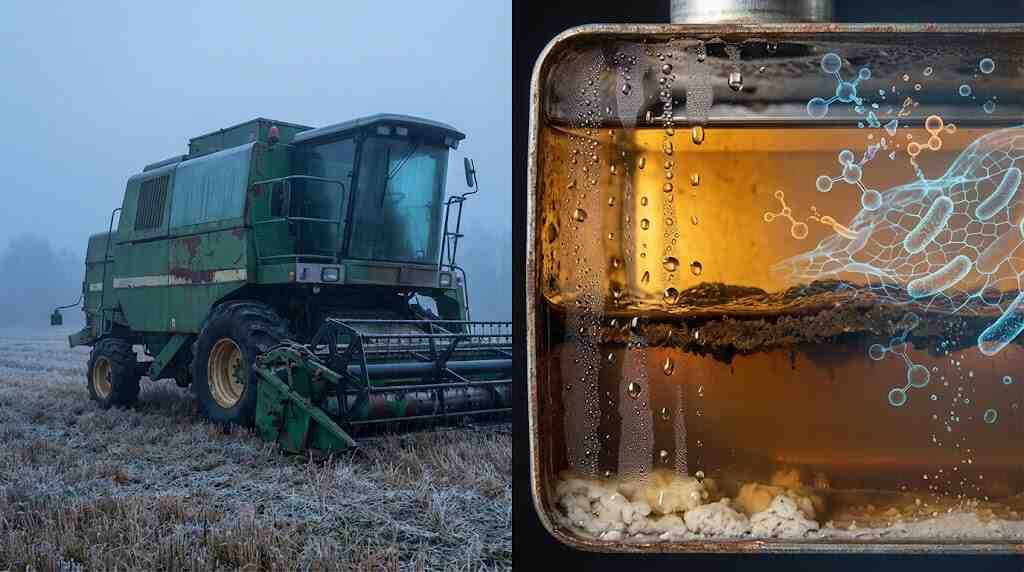
As an expert in fuel technology, I must debunk the popular myth that an idle machine is “resting.” From a chemistry standpoint, the fuel tank of a stationary combine harvester, excavator or motorhome is a bioreactor in which degradation processes occur that are far more dangerous than during continuous operation. In tribology, we describe this scenario as “the machine sits and rots.”
1. THE THERMODYNAMICS OF “TANK BREATHING” (Water Accumulation)
During downtime, the fuel tank is subject to daily cycles of temperature change.
- The physics of the phenomenon: During the day, as the temperature rises, the air in the tank (above the fuel surface) expands and escapes outside through the vents. At night, as the temperature drops, a vacuum forms inside the tank, drawing in fresh, humid air from the atmosphere.
- The effect (Condensation): The moisture contained in the air condenses on the cold metal walls of the tank and runs down to the bottom, because water has a higher density than hydrocarbons.
- The B7/B10 problem: Modern fuels with FAME (Fatty Acid Methyl Esters) added are hygroscopic. Studies indicate that methyl esters absorb 15 to 25 times more water than pure diesel of petroleum origin. This causes the fuel in a stationary machine to actively “drink” water from its surroundings.
2. ESTER HYDROLYSIS (Chemical Acidification)
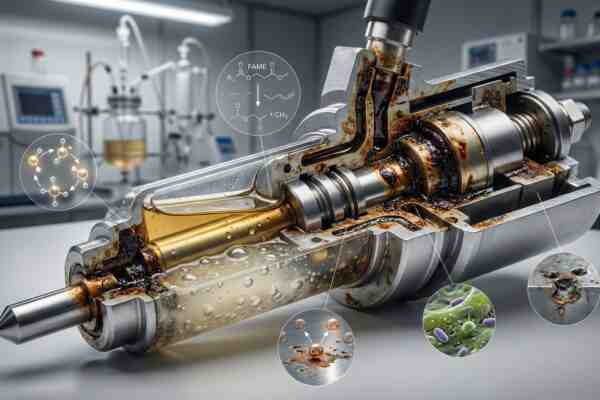
The presence of water at the bottom of the tank (the bottom phase) initiates the process of hydrolysis. This is a chemical reaction in which a molecule of the ester (the bio-component), under the influence of water, breaks down into two components:
- Alcohol (Methanol): Causes corrosion and destroys seals.
- Free Fatty Acids (FFA): These are the main enemy of injectors.
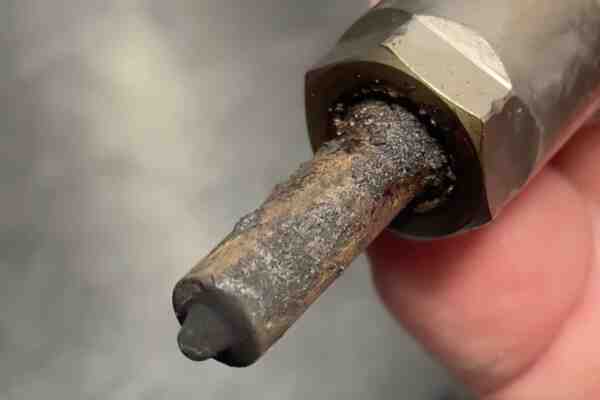
- Scientific evidence: The literature confirms that hydrolysis leads to a sharp increase in the fuel’s Acid Number. The released acids react with metals (e.g. copper from the lines or sodium from manufacturing contaminants), forming Metal Soaps.
- Visual effect: (A white, waxy deposit that clogs pre-filters like “smurf glue”).
3. MICROBIOLOGY OF THE SYSTEM (Life in the Tank)
The water accumulated at the bottom of the tank creates an ideal environment (habitat) for the growth of microorganisms.
- The mechanism: At the boundary between the water and fuel phases, anaerobic bacteria (e.g. sulfate-reducing bacteria) and fungi (e.g. Hormoconis resinae) develop. They feed on the hydrocarbons in the fuel and treat the water as their living environment.
- ITWL/INiG analysis: Studies show that bio-components (FAME) undergo biodegradation four times faster than pure crude oil, which makes them an excellent nutrient source.
- The effect (Biosludge): (A thick, slimy film ranging in color from brown to black, blocking the pickup intake in the tank). In addition, the microbes excrete organic acids that eat away at the bottom of the tank (pitting corrosion).
4. SEDIMENTATION KINETICS (PIMOT Findings)
The most alarming data concern the speed of these processes.
- PIMOT research: The Automotive Industry Institute carried out tests on the storage of B7 and B20 fuels in steel barrels (simulating machine downtime).
- The result: After just 1 month of storage, the amount of insoluble deposits in the B7 fuel exceeded the permissible limit of 25 g/m³.
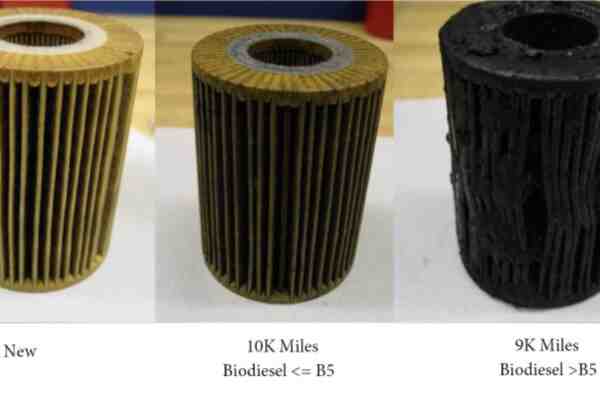
- Interpretation: Fuel poured into the tank in October, by the time you attempt to start the machine in March, is already chemically “dead.” It contains deposits (products of polymerization and oxidation) which, at the first start-up, will be drawn in by the pump, leading to immediate filter clogging or damage to the injection system.
Expert summary: Seasonal machine downtime is more destructive to the fuel system than its continuous operation. The lack of fuel circulation prevents its filtration and heating (which would inhibit microbial growth), while temperature fluctuations pump water into the tank. These phenomena (hydrolysis, microbiology, sedimentation) transform modern B7 fuel into a chemically aggressive mixture of acids and sludge.