The Chemistry of Fuel Ageing: Why Does Your Fuel Tank Have an Expiry Date?
1. Introduction: The invisible process in your tank
As vehicle users, we rarely think of fuel as a “living” substance that undergoes continuous transformations. Yet diesel fuel begins ageing the moment it leaves the refinery. The key parameter that determines how long fuel retains its properties is its oxidation stability. This is a characteristic strictly regulated by European quality standards, such as EN 590.
Oxidation stability is the fuel’s resistance to oxidation, that is, the degradation of its chemical components under the influence of oxygen, temperature and contact with metals. The measure of this stability in laboratory tests (e.g. Rancimat) is the induction period - for standard diesel fuel, the standard sets a minimum of 20 hours.
Fuel is not a substance that remains constant over time; it is a complex mixture of hydrocarbons that reacts with its surroundings, and its main “opponent” in the battle for durability is oxygen from the air.
2. Oxygen and Oxidation: How fuel loses its form
Oxidation is nothing more than a chemical reaction between the fuel’s components and oxygen from the atmosphere. Every contact with air - particularly in a half-empty tank, where there is a large “breathing” space above the surface of the liquid - triggers chain radical reactions leading to degradation.
As a result of oxidation, two key chemical changes occur in the fuel:
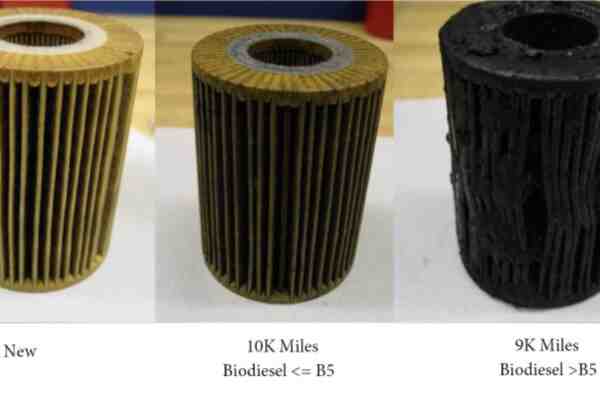
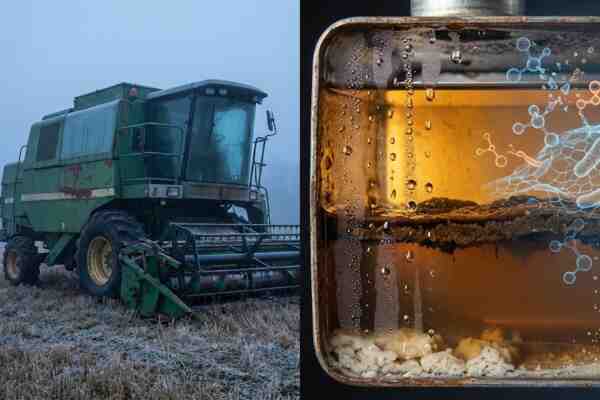
- Formation of deposits and resins: Insoluble high-molecular-weight compounds (polymers) form. Visually, the fuel begins to turn cloudy, changes to a darker colour, and in extreme cases deposits resembling varnish or thick resin appear.
- Formation of organic acids: This process increases the fuel’s so-called acid number, which directly affects the mechanical durability of the system.
Although oxygen is ever-present, the rate of ageing depends on the fuel’s “genetics,” and biocomponents make this process far more dynamic.
3. Biodiesel (FAME) vs. Diesel Fuel: Why does “Bio” require more attention?
Modern diesel fuel (type B7) contains up to 7% fatty acid methyl esters (FAME), which are subject to the EN 14214 standard. Biodiesel, although environmentally friendly, is considerably less chemically stable. This stems from the fact that the FAME molecule contains in its structure about 11% oxygen as well as unsaturated bonds, which are extremely prone to oxidation.
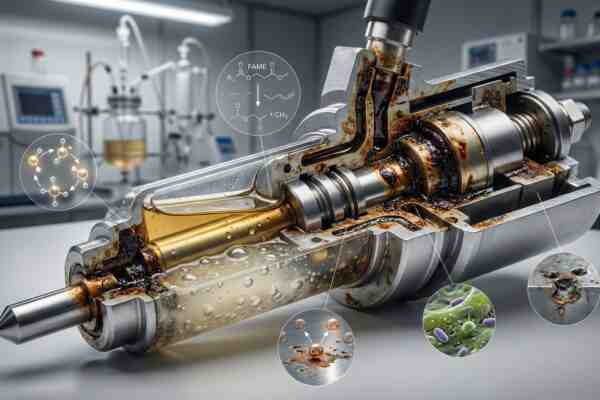
Another challenge is hygroscopicity - biodiesel attracts water like a magnet. The presence of water not only promotes the hydrolysis of esters into free fatty acids, but also creates ideal conditions for the growth of microorganisms that feed on the fuel, excreting corrosive metabolites.
| Characteristic | Classic diesel | Biodiesel (FAME) |
| Susceptibility to oxidation | Lower | Very high |
| Oxygen content in the molecule | Trace | Approx. 11% |
| Water attraction (PN-EN limit) | Up to 200 mg/kg | Up to 500 mg/kg |
| Risk of biodegradation and sludge | Low | Very high |
Even fuel with excellent initial parameters can, however, rapidly lose stability if it encounters copper in the system.
4. Copper: The catalyst that accelerates catastrophe
Copper and its alloys (brass, bronze) act as an oxidation catalyst. In chemical terms, this means that the metal is not consumed, but by its very presence it greatly accelerates the breakdown of the fuel. Studies show that dynamic contact with copper can reduce oxidation stability by as much as 18.5% in a very short time.
In modern vehicles, fuel comes into contact with copper at many critical points:
- Copper washers beneath the injectors.
- Measuring elements and contacts inside the fuel sensors.
- Brass valves, orifices and connectors in the low-pressure system.
Copper acts like a “detonator,” causing ageing processes that would take months in a clean tank to occur within days in the presence of the metal, leading to the formation of deposits that destroy the engine’s precision mechanics.
5. From chemistry to failure: What threatens your engine?
For Common Rail systems, where fuel is forced under pressure exceeding 2000 bar, the products of ageing are lethal. Under these conditions, the smallest resin particles become physical blockages. Experts point here in particular to the problem of IDID (Internal Diesel Injector Deposits) - internal deposits within the injectors.
| Oxidation product | Symptom in the vehicle / Risk of failure |
| Organic acids | Pitting corrosion of metal components, destruction of rubber seals. |
| Deposits and resins (sludge) | Clogging of filters (loss of power), blocking of fuel lines. |
| IDID deposits | “Sticking” of the injector needle, disrupted atomisation, rough engine running. |
Protecting fuel stability is, in effect, protecting the most expensive engine components from premature wear.
6. How to prevent fuel ageing?
To delay degradation, oxidation inhibitors (antioxidants) are used. Interestingly, the most common ones, such as BHT or TBHQ, are “borrowed” from the food industry, where they serve to prevent edible oils from going rancid. Metal deactivators are also used; these chemically “mask” copper ions, so that the fuel stops reacting with them.
The golden rules of fuel protection:
- The 10°C rule: Remember that every 10°C rise in temperature can halve the safe storage time of fuel by 50%. Avoid parking in full sunlight with a low tank level.
- Avoid long-term storage: B7 fuel has its own shelf life. If the car stands unused for several months, the biocomponents may begin to polymerise.
- Fill up before standing idle: This limits the access of oxygen and the condensation of water inside the tank.
- Maintain technical cleanliness: Regularly replacing the fuel filter is the only way to remove water using products such as Diesel System Cleaner and the deposits that have already managed to precipitate.
7. Summary: Your fuel, your responsibility
Fuel ageing is an inevitable chemical process which, in the age of biocomponents, has taken on new momentum. Knowledge of the role of the EN 590 and EN 14214 standards, together with an awareness of the destructive influence of copper and high temperature, allows for effective engine protection. The key to success is choosing fuels with proven oxidation stability and caring for the condition of the injection system - stable fuel is a guarantee of a clean and efficient engine.