Operational Strategy: Managing the Cleanliness and Stability of Fuels in Storage Infrastructure
1. Strategic Context and Operational Risk Analysis
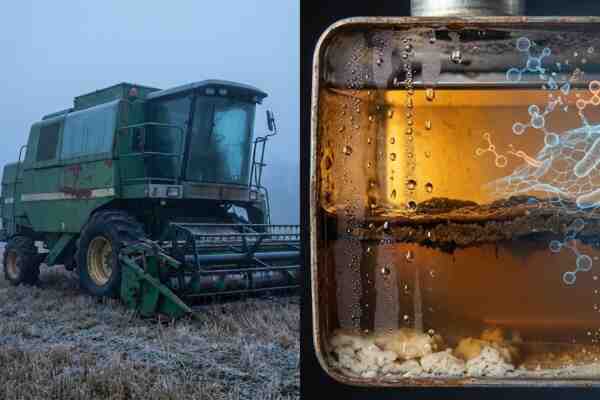
In an era of tightened exhaust emission standards and the evolution of Common Rail-type injection technologies, fuel cleanliness and stability have become the foundation of operational reliability. The contemporary fuel market is characterized by a dynamic increase in the share of fatty acid methyl esters (FAME) and a drastic reduction in sulfur content. Although these changes benefit environmental protection, they introduce new challenges: low sulfur content (a natural inhibitor) combined with the presence of unsaturated bonds in bioesters makes B7 and B100 fuels extremely susceptible to degradation.
From a maintenance perspective, this evolution means that oxidation stability is now a critical factor determining the performance of injection systems. For modern engines, any change in the physicochemical parameters of the fuel can lead to series-type failures, generating enormous downtime costs.
Key Operational Hazards:
- Clogging of filtration systems: Formation of deposits and sludge blocking fuel flow (a drop in filtration efficiency of up to 90% in extreme cases).
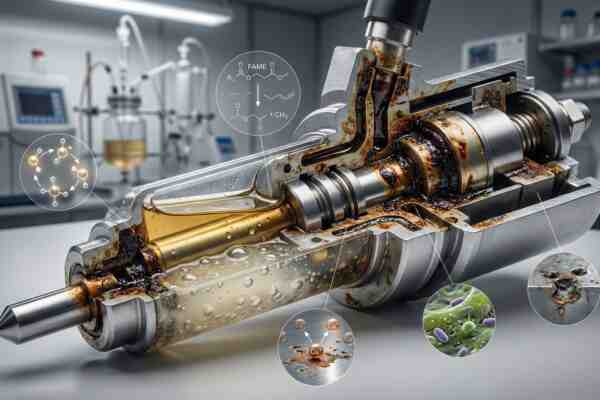
- Internal Diesel Injector Deposits (IDID): Formation of internal deposits in injectors, resulting from the presence of oxidation products (resins and polymers).
- Fuel pump damage: Resulting from the presence of acidic degradation products and abrasive corrosion.
- Biocorrosion of infrastructure: Accelerated degradation of tanks (pitting corrosion) under the influence of aggressive metabolites of microorganisms.
Understanding the technical mechanisms of fuel destruction is essential for implementing effective preventive procedures.
2. Mechanisms of Chemical Degradation: Oxidation Stability and Catalysis by Metals
The chemical aging of B7/B100 fuels is a process of autoxidation, leading to the formation of polymers, resins, and organic acids. FAME is characterized by the presence of unsaturated bonds and a susceptibility to hydrolytic cleavage, which makes biodiesels significantly less stable than pure mineral fuels.
A key catalyst of degradation is the dynamic contact of the fuel with copper and its alloys (brass, bronze) present in fittings and seals. This contact accelerates the oxidation process many times over, which can cause the oxidation stability to drop below the normative limit of 20h, even if the base fuel was of high quality. This requires the use of antioxidants and specific metal deactivators.
Comparison of stability requirements and the impact of design parameters:
| Parameter / Standard | Diesel Fuel (EN 590) | Biodiesel B100 (EN 14214) | Impact of Stabilizers (BioXiten, BHT) |
| Minimum stability (Rancimat) | min. 20 h (at 110°C) | min. 8 h (at 110°C) | BioXiten (INiG-PIB) and phenolic packages delay radical reactions. |
| Deposits (ISO 12205) | max 25 g/m³ | Not applicable (low sensitivity) | Stability >30h at the production stage safeguards the distribution cycle. |
| Sensitivity to copper (Cu) | High (especially FAME >2%) | Extremely high | N,N-disalicylidene-1,2-diaminopropane almost completely eliminates the influence of Cu. |
From a tribochemical perspective, the acidic products of oxidation not only initiate corrosion but drastically reduce the service life of elastomer seals, leading to leaks in high-pressure systems.
3. Fuel Microbiology: The Ecosystem of SRB Bacteria and Fungi
Fuel tanks are an environment in which water (even at a level of 1% v/v or in the form of condensate) plays the role of a catalyst for microbiological growth. FAME, due to its ease of assimilation (hydrolytic release of free fatty acids in a single enzymatic step), constitutes an ideal nutrient medium.
Key biological hazards include:
- Fungi (e.g., Hormoconis resinae): They cause a rapid increase in biomass and clogging of filters.
- Aerobic bacteria (e.g., Pseudomonas aeruginosa): They initiate biofilm formation and the production of biosurfactants, which hinders water separation (emulsification).
- Sulfate-reducing bacteria (SRB, e.g., Desulfovibrio sp.): They develop anaerobically beneath the sludge layer. They produce biogenic hydrogen sulfide (H_2S), which is significantly more aggressive than its chemical counterpart, leading to rapid pitting corrosion of steel.
On the operational level, the extracellular polymeric substances (EPS) secreted by microorganisms act like a “glue,” binding corrosion products and solid contaminants into compact sludge. Such a mixture is the main cause of injector “clogging” and fleet immobilization.
4. Methodology of Monitoring and Laboratory Diagnostics
An effective strategy is based on a quality audit. In the diagnostics of oxidation stability, it is crucial to distinguish between the methods:
- Rancimat (EN 15751): This is the referee (arbitration) method for fuels containing more than 2% FAME. It measures the induction time (resistance to oxidation).
- PetroOxy (EN 16091): A fast, universal method, but one that does not serve as an arbitration method in quality disputes under EN 590.
- ISO 12205: Little sensitivity to biocomponents; unsuitable for assessing modern B7/B100 blends.
Instructions for interpreting microbiological contamination (per cfu/cm³): Note: Exceeding the thresholds requires immediate intervention.
| Number of microorganisms [cfu/cm³] | Interpretation / Tank condition | Recommended action |
| 10³ - 10⁴ | Low contamination | Continuation of standard monitoring. |
| 10⁵ | Medium contamination (increasing) | Intensification of water removal, biocide dose. |
| 10⁶ - 10⁸ | Very high contamination | Mechanical cleaning and chemical disinfection. |
| Presence of SRB | Critical condition | Risk of tank perforation; immediate intervention. |
5. Intervention Strategy: Physical Methods and Precise Dosing
An integrated approach combines mechanical hygiene with precise technical chemistry.
Physical procedures:
- Elimination of the water phase (bottom drainage after each delivery or at least once a month).
- Mechanical removal of sludge and biofilm (cleaning to “shiny steel” in order to avoid the formation of concentration cells).
Chemical intervention (AGQM and INiG-PIB guidelines):
- Antioxidants: Standard dosing (e.g., BHT) at the level of 200 mg/kg (in accordance with AGQM guidelines).
- Metal deactivators: Use of preparations based on N,N-disalicylidene-1,2-diaminopropane (e.g., Keromet MD 100) at a dose of 100 mg/kg in order to completely neutralize the catalytic influence of copper.
- Biocides: Isothiazolone preparations (e.g., Kathon FP) with a broad spectrum, active at the fuel-water interface.
The cost of preventive dosing of BioXiten or metal deactivators is a fraction of the costs resulting from the series replacement of Common Rail injectors affected by IDID deposits.
6. Summary and Operational Recommendations
Managing fuel cleanliness is a continuous process. Oxidation stability and microbiological control must be incorporated into ISO maintenance procedures.
Strategic recommendations:
- Materials engineering: Absolute avoidance of copper, brass, and bronze in transfer systems for fuels with FAME.
- Hygiene schedule: Mandatory dewatering and drying of tanks. Without water, biological life does not exist.
- Cooperation with INiG-PIB: Use of proven solutions, such as the BioXiten/TEC2000 DSC additive, especially with planned storage exceeding 6 months.
- Visual monitoring: The first warning signal is a change in color (darkening) and a loss of fuel clarity.
Checklist for the Fuel Infrastructure Operator:
- Has the visual “Bright & Clear” test been carried out (no suspended matter and no turbidity)?
- Has darkening of the fuel been observed compared to the reference sample?
- Has water been removed from the bottom drainage in the current month?
- Did the most recent test by the Rancimat method (EN 15751) show an induction time >20h?
- Do the filters show the presence of fibrous sludge with the smell of hydrogen sulfide (H_2S)?
Continuous control of fuel parameters is the only way to ensure the long-term reliability of Common Rail systems in modern fuel infrastructure.