The engine started drinking oil, the power quietly slipped away, and at the garage someone said the word “cylinder”. Before you picture the worst and an expensive rebuild, it pays to understand what the cylinder actually is, what goes wrong inside it, and which problems you can still clean out versus the ones no chemical will ever undo.
What is an engine cylinder?
The engine cylinder is the chamber where the piston travels, closed at the top by the head and forming the combustion space. Its inner wall is a thin liner or a coating on the block. The piston, sealed by rings, slides on a film of oil rather than on dry metal, and it is this piston-rings-bore trio that governs compression, power and oil consumption.
How is a cylinder built? Bore, wet and dry liners
A cylinder is not just a plain tube. What matters most is its inner wall, the bore, and whether that wall works directly in the block or in a separate liner. That decides how heat is drawn away, how long it lasts, and whether it can be replaced without scrapping the whole block.
The cylinder bore and honing
The cylinder bore is created by a machining process called honing, which sets the diameter and the wall texture for the rings with real precision. The distinctive crosshatch pattern, those intersecting grooves, is not there for looks. Those microscopic “valleys” hold the oil film, and the piston’s motion spreads it across the wall. That keeps metal off metal and keeps the rings sealing.
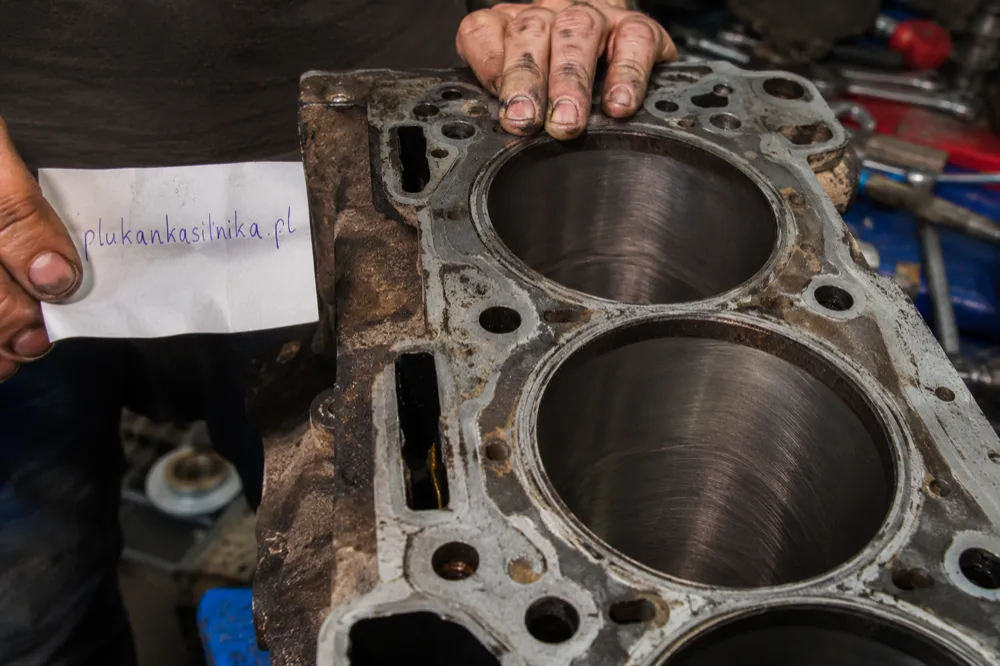
Shops use what is called plateau honing, done in two stages: a coarse pass cuts the valleys, and a fine pass flattens the peaks. The result is deliberate. Slightly rough peaks help fresh rings bed in, the flattened plateaus give a durable load-bearing surface, and the valleys still store oil. The crosshatch angle typically sits at roughly 45 degrees. Too steep a pattern holds oil poorly, which is why nobody hones a rebuild “by eye”.
Liners: wet versus dry
A liner is a replaceable insert that forms the cylinder wall, and it is split into wet and dry by a single criterion: contact with the coolant. A wet liner touches the coolant directly, so it dumps heat straight into the cooling system. A dry liner has no such contact, sits tight against the block, and passes its heat out through it.
| Feature | Dry liner | Wet liner |
|---|---|---|
| Contact with coolant | None (sits against the block) | Direct |
| Heat removal | Through the block | Straight into the coolant (better) |
| Wall thickness | Thin insert (roughly 1.5-3 mm) | Thicker (roughly 3-6 mm) |
| Replaceability | Harder | Easier |
| Typical use | Lighter-duty engines | Diesels, heavily loaded units |
You will mostly find wet liners in diesels and hard-working engines. They are easier to swap because they are a separate part rather than an integral piece of the block (MAHLE, one of the leading suppliers, makes exactly this kind of component). The thickness figures are given as a rough guide, since they vary between designs.
Materials: cast iron, Alusil, Nikasil
The cylinder wall gets made from different materials, and that is not fashion but a trade-off between weight, durability and cost.
| Material | What it is | Practical trait |
|---|---|---|
| Grey cast iron | The classic wall or liner | The benchmark for durability |
| Alusil | Hypereutectic aluminium-silicon alloy (over 12% Si); machining exposes hard silicon crystals that hold the oil | Lets you build aluminium blocks with no liners; less hard-wearing than iron, so the piston needs a coating |
| Nikasil | A nickel coating with silicon carbide (SiC), electroplated on and then honed | Very durable (per published analyses, many times over iron); piston needs no special coating |
What does the cylinder do in the four-stroke cycle?
The cylinder handles four jobs at once, and only together do they make a working engine:
- it guides the piston on its axis so it runs true, with no side-to-side slap,
- together with the rings it forms the seal that stops the compressed charge escaping into the crankcase, which is how compression builds,
- it draws off and spreads heat, by air through fins on air-cooled engines or by coolant in the block,
- it closes the combustion chamber, where the burning gases shove the piston down and turn combustion into torque.
Compression is the linchpin here. The rings form the seal against the bore. When they wear or coke up, they leak pressure into the crankcase, and that means lost compression and lost power. If low compression shows up in just one cylinder, it is usually a local fault: a burnt or bent valve, a damaged seat, a worn ring or a holed piston. Mechanics use a simple wet test: a few drops of oil down the plug hole. If compression then rises, the rings are to blame. If it does not budge, look to the valves or the head gasket. Low compression across two neighbouring cylinders is the classic sign of a blown head gasket.
How many cylinders does an engine have, and why more than one?
An engine can have a single cylinder, like a lawnmower, or a dozen or more, like large units, and the count comes from a trade-off between power, smoothness and size. Each cylinder is a separate act of combustion. More cylinders mean more of those firing events per cycle, so potentially more power and smoother running, because the firing strokes spread out more evenly.
Tied to the cylinder is the idea of swept volume, the space the piston “sweeps” from bottom to top of its travel. Add up those volumes across every cylinder and you get the engine’s displacement, the figure on your registration document. Common passenger units run on the order of a few hundred cubic centimetres per cylinder, but the exact number depends on the design, so there is no single “average” figure to state here as a rule.
What destroys the cylinder and its bore? Deposits versus mechanical wear
Two very different mechanisms wreck a cylinder, and that distinction is the single most important thing in this whole subject: deposits, which you can largely clean away, and mechanical loss of material from the wall, which no chemical will reverse. Confusing the two leads to disappointment, because someone pours in a flush where what is really needed is a boring bar.
| Problem | What happens | Reversible? | Action |
|---|---|---|---|
| Deposits and varnish in the grooves, stuck rings | The ring stops floating, loses its seal, blow-by appears and oil consumption climbs | Partly yes | Cleaning, flushing, decarbonising, oil change with detergents |
| Carbon on the wall and piston crown | Oil breaking down at high temperature | Partly yes | Chemical deposit removal |
| Ovality and taper of the bore | Material worn away by side thrust from the piston | No | Overbore honing plus oversized pistons |
| Scoring, scuffing, seizure | Deep vertical damage to the wall | No | Boring oversize, liner replacement or reconditioning |
Deposits and carbon on the walls and in the ring grooves
Deposits in the ring grooves are partly reversible, because they build up from oil breakdown products rather than from lost metal. Ageing oil reacts with oxygen and forms sticky deposits, a sort of varnish or lacquer, that coat the parts. Heat piles on top of that, breaking oil down into engine oil coking and hard carbon in the grooves.
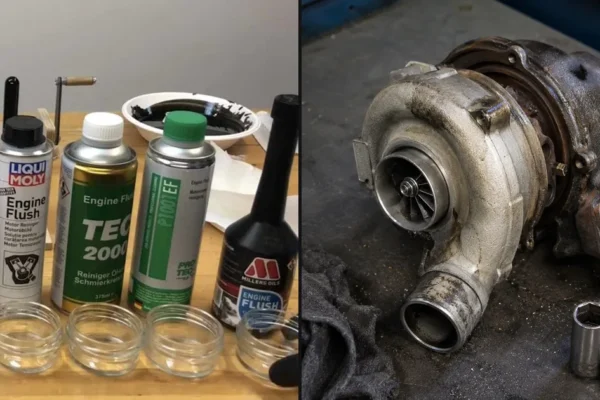
The trouble turns serious when there are enough deposits to jam the rings. The phenomenon is called ring sticking. The ring stops “floating” in its groove, a gap opens between it and the bore, gases push through it (blow-by), oil consumption rises, and in the worst cases the ring can crack. This is where chemistry genuinely helps. Detergents and dispersants react with the deposits, hold them in suspension and stop them baking on, while regular oil changes do the preventive work. Freeing stuck rings and lifting deposits off the bore is exactly what a TEC 2000 engine flush is for, circulated through the oil system before an oil change. It is an advanced blend of hydrocarbon solvents on an aromatic base with an additive package, chlorine-free and free of kerosene, formulated to be seal-safe. It is worth being clear about what such a treatment actually does, though. A flush helps remove deposits and free stuck rings, but it will not rebuild a worn bore. If you want to do it properly, we have laid out the engine flush step by step.
Mechanical wear of the bore: ovality, scoring, seizure
Mechanical wear of the bore is irreversible, because it means a physical loss of material from the wall. Side thrust from the piston gradually causes ovality, the loss of a perfectly round cross-section, along with taper, where the diameter at the top of the cylinder differs from the one at the bottom. Most of the wear is usually near the top, where the ring reverses direction and the oil film is thinnest.
The worse scenario is overheating or a broken ring, which leave deep vertical grooves, that is scoring. A separate chapter covers the scored cylinder bore and its symptoms, oil burning among them, which we go into elsewhere. In cases like these, chemistry is helpless. The fix is boring, machining the cylinder oversize and fitting larger pistons and rings, or replacing the liner. After boring you still hone the wall, to knock off the peaks, even out the surface and give it the texture the new rings need. That is reconditioning, not cleaning, and this is the hard line between what you can flush out and what has to go on a machine.
Frequently asked questions
Will a flush fix a worn cylinder?
No. A flush removes deposits and frees stuck rings, but it will not rebuild lost material in the bore. Ovality, taper or deep scoring get fixed only mechanically, by boring oversize or replacing the liner.
What is the difference between a wet and a dry liner?
The criterion is contact with the coolant. A wet liner touches the coolant directly and sheds heat better, a dry liner sits against the block and passes heat out through it. Wet liners are used mainly in diesels and heavily loaded engines, because they are easier to replace.
Why is the cylinder bore honed?
Honing sets the diameter and gives the wall the crosshatch pattern that holds the oil film. That keeps the piston off dry metal, keeps the rings sealing, and lets fresh rings bed in. Without that pattern the oil would not stay on the wall.
What does low compression in one cylinder mean?
Usually a local fault: a worn or coked ring, a burnt or bent valve, a damaged seat or a holed piston. A wet test helps tell them apart: if compression rises after adding oil, the rings are at fault, if it does not, look to the valves or the gasket.
How many cylinders should an engine have?
There is no single right number. More cylinders give more combustion events, so potentially more power and smoother running, but also more size and cost. It is a trade-off, which is why you see everything from single-cylinder units to twelve and beyond.
Can cylinder deposits be removed without stripping the engine?
Partly yes. Deposits and varnish in the ring grooves react with detergents and dispersants, so chemical cleaning and regular oil changes can free stuck rings. Lost bore material cannot be rebuilt this way.
What is the cylinder wall made of?
Most often grey cast iron, the durability benchmark, or in aluminium blocks the Alusil alloy or a Nikasil coating. Alusil exposes hard silicon crystals under machining to hold the oil, while Nikasil is a durable nickel coating with silicon carbide.