A petrol engine flush is a job that drivers often skip. It is done at an oil change: you pour the flush into the old oil, let the engine idle for the time on the label, usually 10-15 minutes, and drain everything together. No specialist equipment is needed. This guide covers when a flush makes sense, how flushes differ, how to carry one out step by step and what is specific to petrol engines: GDI, turbo and LPG.
1. What is a petrol engine flush and why is it important?
A flush dissolves the deposits that collect in the engine, and the oil you drain carries them away.
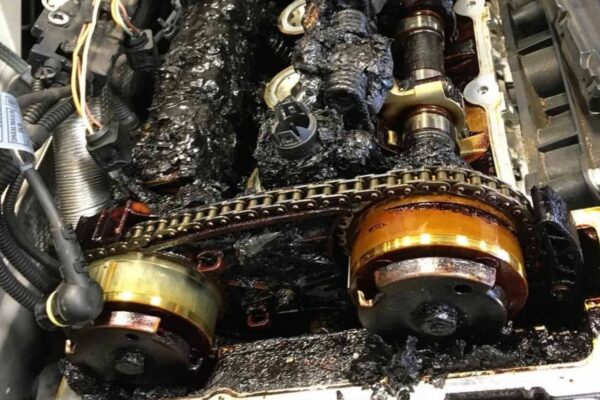
Deposits build up from the first kilometres, even when the oil is good and changed on time. The detergent in the oil keeps soot and oxidation products from settling, but it will not take off a deposit that has already stuck to the metal, because that deposit has to be dissolved. The most damage is done by hard carbon in the piston ring grooves: it takes away the rings’ freedom of movement, and oil the ring cannot scrape off gets burnt.
2. When and how often should a petrol engine be flushed?
There is no single interval for all petrol engines, and no mileage after which a flush becomes mandatory. Flushing works best as prevention, at the oil change: every change or every second one. Whether to flush more often depends on driving style, the technical condition and age of the car, and how the oil has been changed so far. A car bought without a confirmed service history is worth flushing at the first oil change after purchase.
A flush is not a cure-all: it removes deposit, but it will not solve mechanical problems. On an engine serviced on time a one-off flush changes little, because there is still little deposit to dissolve. Its role then shifts from rescue to prevention. If you are not sure what condition your engine is in, ask a mechanic.
3. Types of fluids for flushing a petrol engine: What to choose?
Flushes differ in solvent base, additives and working time. The one you will meet most often is a flush additive: you pour it into the old oil, let the engine idle for ten to fifteen minutes and drain it together with the oil. A flushing oil replaces the engine oil for a short idle run and works more gently. There are also long-acting products, which are counted in kilometres and come with their own instructions. Kerosene, diesel and water are not flushes. The full comparison is in our guide what to flush your engine with: engine flush, kerosene, water or diesel.
The procedure below is for a short flush poured into the old oil. A flushing oil and a long-acting product come with the manufacturer’s own instructions.
4. Step by step: How to correctly carry out a petrol engine flush?
Warm the engine up to operating temperature, for example with a short ride, and switch it off. Get the new oil, an oil filter and the flush ready. Choose a product suited to your engine and check the manufacturer’s instructions, including the amount and the running time. Pour the flush through the oil filler into the old oil. Do not drain the oil before the treatment: the flush works in the oil, and the engine must not run without it.
Start the engine and leave it idling for the time on the label, usually 10-15 minutes. Do not rev it and do not drive. Then switch the engine off and drain the oil together with the flush straight away, while it is still hot, because the dissolved deposits leave with the oil. Refit the drain plug, replace the oil filter and fill with fresh oil. After starting, check the oil pressure and look for leaks. Dispose of the used oil in line with the regulations.
Which flush is best for a petrol engine
There is no separate chemistry “for petrol”. A flush dissolves the oxidation products of the oil, and those form the same way in every combustion engine. The choice therefore depends not on the fuel but on the condition of the particular engine and on what the manufacturer has declared in the safety data sheet.
In practice it comes down to three questions. What is the base: an aromatic one washes more aggressively, a dearomatised paraffinic one more gently. Does the sheet list an anti-wear additive, such as ZDDP or sulphurised olefin, which protects the sliding parts during the ten to fifteen minutes on thinned oil. And is there a detergent that keeps the loosened dirt in suspension until the oil is drained.
A well-kept engine with regular oil changes will cope with any sensible flush. A high-mileage unit with a history of skipped changes is a different conversation: a milder formula used twice at consecutive oil changes is often wiser than one aggressive treatment. We wrote about such engines in the guide engine flush on a high-mileage engine. The full comparison is in the ranking of engine flushes by composition.
What is specific to petrol engines
Three things set a petrol engine apart from a diesel when it comes to the cleanliness of the oil system.
Direct injection. In GDI, TSI or FSI engines the fuel goes straight into the cylinder, so it no longer washes the intake valves. Deposit from the crankcase ventilation settles on them and hardens. An oil flush will not touch it, because it is a different circuit. It is worth knowing so as not to expect a miracle: carbon on the intake valves is removed mechanically, or chemically from the intake side.
Turbo and coking. A turbocharger on a petrol engine runs hotter than on a diesel. Oil in the bearing passages can coke, especially after a hot engine is shut off abruptly. A clean oil system really helps here, because carbonised deposit starts from contaminated oil.
LPG installation. Gas burns hotter and drier, which raises the temperature of the valves and of the whole upper part of the engine. The oil ages faster and the deposit can be harder. On cars running on gas it makes sense to shorten the oil change interval and to check what is going on under the filler cap.
In short: there is no single interval, and the most is gained by flushing as prevention at the oil change. The procedure itself is a warm engine, the flush poured into the old oil, 10-15 minutes at idle (the time on the label), an immediate drain, a new oil filter and fresh oil. A flush removes deposit but will not repair mechanical wear, and any doubts about the condition of the engine are worth discussing with a mechanic.
Not sure whether your problem is the oil or the fuel? We separate the two in the guide engine oil flush vs injector cleaner: which one to choose.