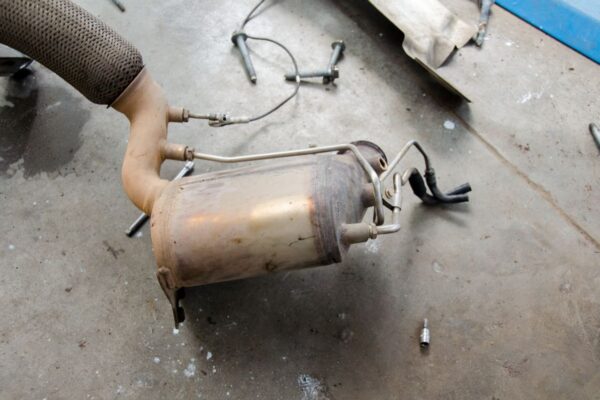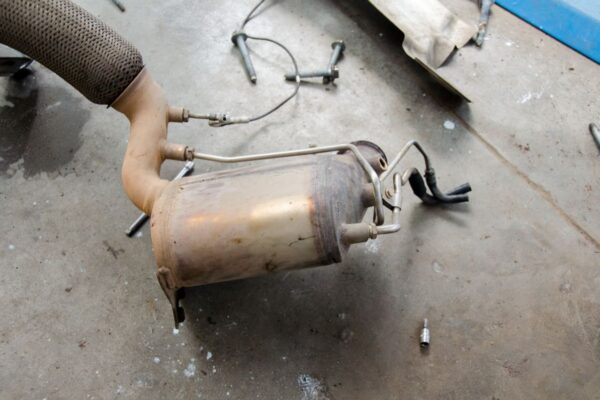
A particulate filter clogs up and fails to regenerate for the same reasons, so the two questions are worth settling together. Below: what actually builds up inside it, why regeneration does not complete, how to check it from the ECU, and what can no longer be reversed.
What builds up in the filter: soot and ash
This distinction decides everything that follows, and it rarely gets mentioned. Two different things accumulate in the filter.
Soot is carbon from incompletely burnt fuel. It burns off during regeneration, and after a successful cycle the filter really is clear of it.
Ash is mineral residue, mostly from the additive package in engine oil, small amounts of which always reach the combustion chamber. Ash does not burn at any temperature achievable in an exhaust system. It stays permanently and takes up more room with every thousand kilometres.
That is why a high-mileage filter regenerates more and more often and holds out for less and less time. It is not faulty, it is simply full of something that cannot be burnt away. We set the mechanism out in more detail under the DPF warning light.
Why the DPF does not regenerate
- Nothing but short trips. Active regeneration needs a good fifteen minutes of driving under load. Switch the engine off halfway through and the cycle not only fails, it leaves injected fuel in the oil.
- Interrupted regenerations. Several unfinished cycles in a row mean rising soot loading and ever more frequent attempts, until the ECU stops trying and puts the light on.
- The EGR valve. A faulty one lowers exhaust temperature, and below a certain point soot will not ignite.
- Engine condition. Worn rings or leaking injectors produce more soot than the filter can burn off.
- Sensors. A failed differential pressure or exhaust temperature sensor gives the ECU a false picture, so it either never starts a regeneration or runs one pointlessly.
- The wrong oil. Ordinary full-additive oil leaves ash behind. An engine with a particulate filter needs a Low SAPS oil, with reduced sulphated ash, phosphorus and sulphur.
- Poor fuel. More soot going in means the filter fills up faster.
How to check whether the DPF is clogged
The symptoms point you in the right direction: the engine running worse, higher fuel consumption, weaker acceleration, sometimes limp mode. Those are circumstantial evidence, though, not an answer.
Certainty comes from a diagnostic tool, which reads two values from the ECU: the calculated soot loading in grams or percent, and the distance since the last successful regeneration. If loading is climbing and the distance counter has not reset in thousands of kilometres, the filter is not regenerating. That second figure tells you more than the first one on its own.
Check the oil level while you are at it. If the dipstick shows more than you put in, that is the classic trace of interrupted regenerations: fuel injected late in the cycle runs down the cylinder walls into the sump and dilutes the oil.
How to prevent it
- Longer runs under load. Not hard driving, just a good fifteen minutes at steady higher revs so the exhaust gets properly hot.
- Do not switch off mid-regeneration. Many cars signal it with a raised idle or a distinct smell. Finish the cycle where you can.
- Low SAPS oil. It is the only item on this list that directly governs how much ash forms, and therefore how long the filter lives at all.
- A working EGR and sensors. Cheap to fix, expensive to ignore.
- Decent fuel. Less soot going in means fewer regenerations.
Common questions
Can I clean the DPF myself?
Cleaning kits exist, but without a forced regeneration at the end the result is half a job, and without specialist equipment you will not remove everything. What the workshop procedure involves, and where its limit lies, is set out under DPF cleaning without removal.
Can I force a regeneration myself?
By driving under load, yes, and that is the first thing to try. Leave a tool-forced regeneration at very high loading to a workshop, because on a badly clogged filter the temperature can damage it.
Is removing the DPF an option?
No. It is illegal, it fails the roadworthiness test, it carries real legal consequences, and it causes trouble when you sell the car.
Can I drive with a clogged DPF?
Briefly and gently, yes, but it is not a state to maintain. Back pressure rises, power drops, fuel consumption climbs, and every failed regeneration attempt adds more fuel to the oil.
Is a DPF replaced at set intervals?
No. A particulate filter is not a service item with a replacement interval the way an oil or air filter is. It is meant to last the life of the car. When it stops coping, the order runs: regeneration first, then off-car cleaning, and a replacement element only at the end, once the filter has filled with ash.
Summary
Clogging and failed regeneration are one problem seen from two sides. Soot can be burnt off, and there driving style and engine condition do the work. Ash can never be burnt off, and there only the right oil matters. Everything else, meaning the EGR, the sensors and the fuel, decides how quickly you reach the point where only cleaning or a new element is left.
A well-maintained filter means fewer trips to the workshop and a smaller bill, because replacing the element is one of the more expensive jobs on a diesel.