The Process of Microbiological Fuel Contamination: From a Drop of Water to Engine Seizure
Microorganisms in the fuel system are not just a biological curiosity, but one of the most insidious enemies of modern technology. As engineers and operators, we often forget that a fuel tank is not a sterile flask, but an ecosystem teeming with life. Below, we will analyze how bacteria and fungi invisible to the naked eye are able to turn high-quality diesel fuel into a substance destructive to the engine.
1. Invisible Passengers: Where do the microorganisms in the tank come from?
Although hydrocarbon fuel seems like an unfriendly environment, for many microorganisms it is an excellent source of carbon and energy. They get into the system through several routes:
- Primary contamination (Refinery and Transport) - Already at the production stage, the fuel may come into contact with microbial spores present in pipelines and tankers.
- Air and dust - During every refueling, air is drawn into the tank. Along with it, fungal spores and soil particles that carry bacteria enter inside.
- Contaminated dispensers - Filling nozzles at stations, if not cleaned regularly, act as points of infection transfer between vehicles.
- Resilience (Hidden Strength) - Microorganisms are able to persist in fuel in a dormant state. They wait for the moment when the right conditions appear for a sudden demographic “explosion”.
Mechanism: Entry route -> Settling -> Waiting for an activator.
Important: The mere appearance of microbes is only half the problem. For a catastrophe to occur, an “elixir of life” is needed, which in the world of fuels is water.
2. Water: The Trigger in a Hydrocarbon Environment
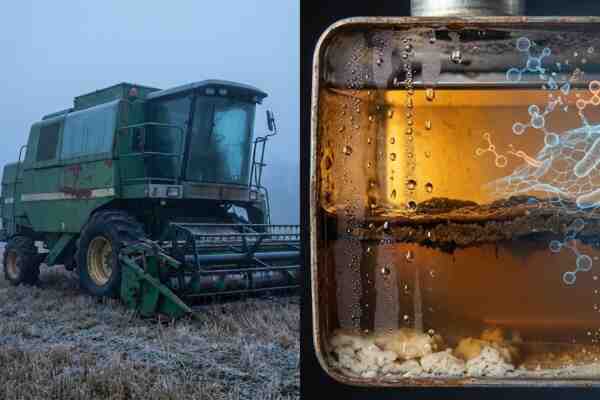
Water is absolutely essential for the life of microorganisms. To initiate cell division processes, just 1% (v/v) of water in the fuel is enough, and in extreme cases even a microscopic layer of moisture condensed on the tank walls.
It is worth looking at the numbers to understand the scale of the threat. The PN-EN 590 standard allows only 200 mg/kg of water in standard diesel fuel (ON). In the case of Biodiesel (FAME), the PN-EN 14214 standard permits 500 mg/kg. When 1% water appears in the tank (i.e. 10,000 mg/kg), we are dealing with a drastic exceedance of the standards, which turns the tank into an ideal incubator.
Susceptibility comparison: Diesel vs Biodiesel (FAME)
| Characteristic | Diesel Fuel (ON) | Biodiesel (FAME) |
| Water solubility | Low (max 200 mg/kg) | High (max 500 mg/kg) |
| Oxygen content | Practically none | High (~11%) - “Oxygen included in the package” |
| Susceptibility to microbiology | Moderate | Very high (readily available fatty acids) |
| Growth mechanism | Mainly at the phase boundary | Throughout the entire volume (thanks to oxygen and water) |
Why does Biodiesel spoil faster? FAME is a fuel “with oxygen included in the package”. Aerobic microorganisms (aerobes) have an easier task there - they do not have to wait for oxygen from the air above the fuel surface, because they have plenty of it in the very chemical structure of the bio-additive. That is why B7 or B20 blends are much more exposed to infections.
3. The Mechanism of “Eating” the Fuel and the Biological Superglue
The metabolic process in which fuel turns into sludge is a fascinating, albeit destructive, cascade of events:
- A Feast of Biogens: Microbes take carbon from the fuel, and nitrogen, phosphorus and sulfur from the performance-enhancing additives.
- Species succession: First, aerobes develop, consuming oxygen (including that from FAME). When the oxygen runs out, the dangerous anaerobes (e.g. SRB bacteria) come to the fore, producing hydrogen sulfide.
- EPS Production (Biological Spider Web): Microorganisms secrete extracellular polymeric substances (EPS). Imagine this as a biological superglue or a dense spider web. This sticky matrix not only protects the cells, but actively captures rust, dust and metal particles from the fuel.
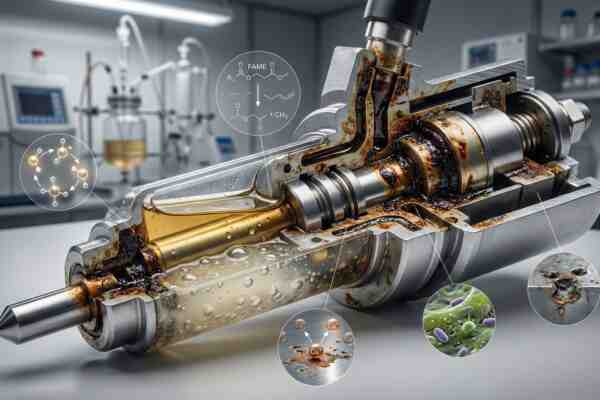
- Self-Destruction Loop (Copper Catalysis): Microbes produce organic acids that “digest” copper from the lines and seals. The released copper ions act as a powerful catalyst that further accelerates the oxidation of the fuel. This is a self-perpetuating cycle of destruction.
4. Operational Consequences: The Anatomy of Destruction
The presence of microbes in the fuel system is a deferred sentence for the engine equipment.
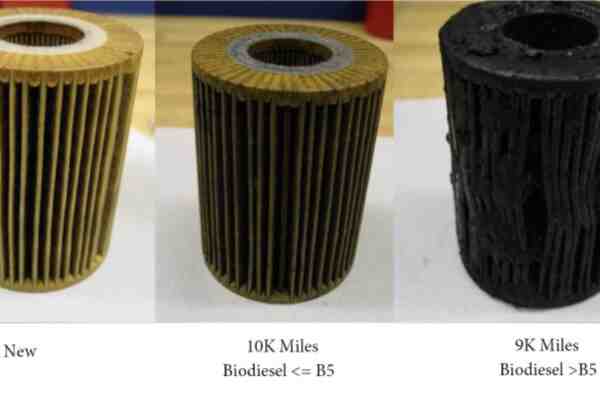
- Filter blockage: A standard filter has pores of 10 μm in size. The fibrous chains of fungi and biofilm flakes (our “superglue”) rapidly clog these micro-openings. The engine chokes, loses power and stalls.
- Biocorrosion of Aluminum and Steel:
- Fungi such as Hormoconis resinae are particularly aggressive towards aluminum alloys (common in pump and filter housings). They selectively digest the metal along the grain boundaries, creating deep pits that do not undergo passivation (do not “heal over”).
- SRB bacteria produce hydrogen sulfide (H2S), which “perforates” the bottom of steel tanks.
- Financial Catastrophe: “So what?” - the cost of repair is not just a new filter. It is often the replacement of entire injector rails (Common Rail), chemical cleaning of the tank and reconditioning of the high-pressure pump.
3 Warning Signs of Infection:
- Rough running and sudden stalling (a signal that the filter is clogged with sludge).
- Cloudy, dark fuel of an unnatural color.
- Smell of rotten eggs (presence of hydrogen sulfide produced by SRB bacteria).
5. The Culprits in Your Tank
| Group | Species (example) | Environment | Main “sin” |
| Filamentous fungi | Hormoconis resinae | Aerobic (Aerobes) | Formation of fibers, biocorrosion of aluminum, blockages. |
| Aerobic bacteria | Pseudomonas aeruginosa | Aerobic (Aerobes) | EPS production (superglue), rapid fuel degradation. |
| Anaerobic bacteria | Desulfovibrio (SRB) | Anaerobic | H2S production, pitting biocorrosion of steel. |
| Yeasts | Candida silvicola | Variable | Decomposition of biocomponents (FAME), clouding of the fuel. |
6. Summary and Golden Rules of Prevention
Microbiological contamination is an avalanche-like process. A single bacterial colony can double its numbers in 20 minutes, and the product of their metabolism is… water, which creates the conditions for subsequent generations.
Golden rules of prevention:
- Water is enemy number 1 - Regular dewatering of tanks is the foundation. Without water, life in the tank dies out.
- The separator is your first line of defense - Keep the settling chambers and water separators upstream of the main filter clean.
- Tank hygiene - Periodic mechanical cleaning is essential to remove the biofilm, which biocides alone will not “dissolve”.
- Chemistry - Regular use of products [np. TEC2000] that remove water and protect the tank so that it does not turn into a sour brew significantly extends the life of the injectors and of the entire fuel system, including the pump.
- Biocides and technology - In the case of infection, use preparations based on isothiazolones. Consider magnetic devices that disintegrate the cells before they reach the filter.
Final conclusion: Ignoring the “life” in the tank is the most costly operational mistake. The biofilm not only clogs filters - it actively “digests” your fuel system from the inside, leading to irreversible corrosion damage.