The question “which brands have a DPF” is badly framed, which is why it has no sensible answer. The badge on the bonnet does not decide, the emission standard the car had to meet on the day of registration does. A Volkswagen, a Toyota and a Dacia of the same year all have one, because all three faced the same rules. What counts is fuel, year and standard.
The emission standard decides, not the brand
| engine type | standard | in practice from | filter |
|---|---|---|---|
| diesel | Euro 5 and later | registrations from 2011 | practically always a DPF |
| diesel | Euro 4 | 2006 to 2010 | sometimes, model dependent |
| petrol, direct injection | Euro 6d and variants | registrations from 2018 | practically always a GPF |
| petrol, port injection | any | - | usually none |
The sections below explain where those dates come from and where the exceptions sit.
Diesels: from Euro 5, essentially all of them
Euro 5 lowered the permitted mass of particulate matter to a level unreachable by combustion tuning alone. Manufacturers had one option left: fit a filter. Formally the regulation never says “a DPF is required”, but in practice that is exactly what it meant.
So the rule is easy to remember. A diesel first registered from 2011 onwards almost certainly has a filter, regardless of brand or class. That holds for a large estate and a small city car alike, for premium and budget marques alike.
Model years 2009 and 2010 are a transition period, because new type approvals had to meet Euro 5 before all registrations did. A car from that window may still be Euro 4 or already Euro 5, depending on when that model entered production.
Earlier exceptions
Some manufacturers fitted filters long before they had to. The best known case is the PSA group, which from 2000 offered a system known as FAP, with a separate tank of additive that lowers the temperature at which soot burns.
That matters practically to owners of older cars. If you have an early two-thousands diesel and notice an extra fluid reservoir under the boot floor or in a wheel arch, that is not screenwash. It is filter additive that needs topping up, and many subsequent owners have no idea.
Petrol: the filter few people know about
This is where the page needed the biggest correction, because the common belief that “only diesels have filters” is out of date.
Direct injection petrol engines produce far more fine particles than older port injection designs, because fuel enters the cylinder directly and has less time to mix with air. Once regulations began limiting particle number rather than only mass, manufacturers started fitting filters to petrol cars too. It is called a GPF and works on the same principle as a DPF.
In practice this means a direct injection petrol car registered from around 2018 almost certainly has a particulate filter. Owners frequently have no idea until they see a warning light or a replacement quote.
How to recognise direct injection is covered in the article on types of injectors. The abbreviations in the version name usually settle it: FSI, TSI, GDI, THP and similar all mean direct injection.
Who has no filter
Cars without one are mainly older petrol engines with port injection, where fuel enters the intake manifold. They produce few enough particles that no extra device is needed to meet the limit.
Also without one: diesels older than Euro 4, historic vehicles, and machinery outside automotive regulation. And that is roughly the whole list, because in new passenger cars a filter is now the rule rather than the exception.
How to check for certain
Four ways, from quickest to most reliable.
The registration document. The emission level or Euro standard is often noted in the annotations field. Euro 5 or higher on a diesel means a filter.
A parts catalogue by VIN. If the listing for your specific car includes a “particulate filter” entry, that settles it.
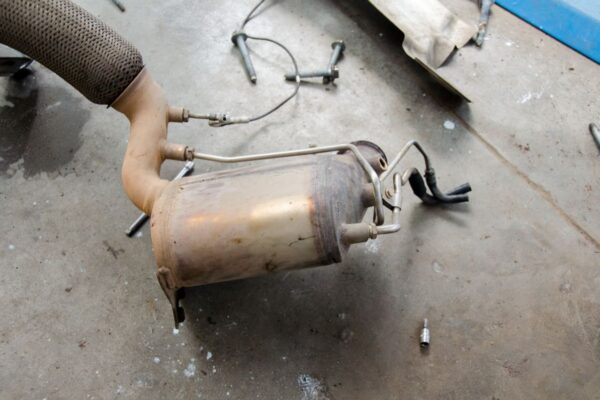
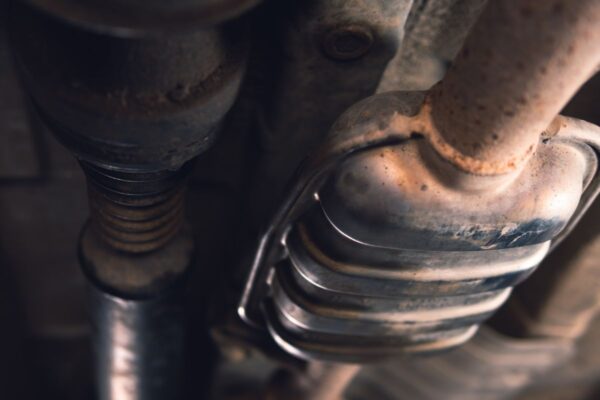
Looking underneath. The filter is a swelling in the exhaust, usually after the catalytic converter, with two thin pipes running to a differential pressure sensor and normally a temperature sensor too. Those little pipes are a good giveaway.
A diagnostic tool. The most reliable method. If the ECU displays a soot loading parameter or distance since the last regeneration, the filter is definitely there and definitely working. We gathered more on checking in the article on how to tell whether your car has a DPF.
A correction: the filter does not lower fuel consumption
This needs setting straight, because an earlier version of this page listed as a benefit that filtering particles makes “the engine run more efficiently and use less fuel”.
The opposite is true. The filter has no influence on combustion inside the cylinder, because it sits downstream and merely catches what the engine has already released. Meanwhile, periodically burning off soot demands an extra dose of fuel, so a car with a filter uses slightly more, not less. How much and what it depends on is set out in the article on DPF and fuel consumption.
The filter exists for one reason: to keep particulate matter out of the air we breathe. That is reason enough, and there is no need to pile on benefits it does not have. The claim that a filter “increases engine durability” is equally untrue. It neither increases nor decreases it, as long as it flows freely.
What next, if you do have one
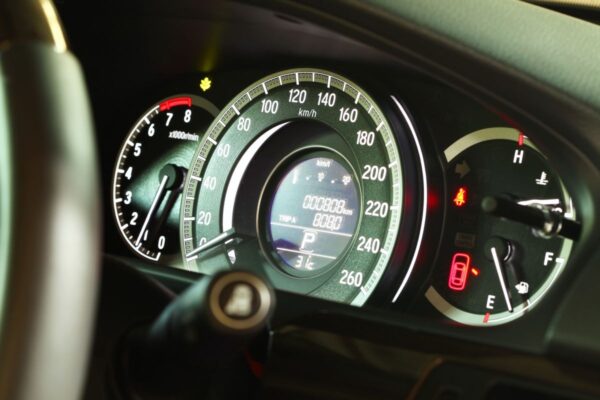
Two things are worth knowing. First, the filter warning light usually does not mean a failure, it means a regeneration that did not complete, and a longer drive is normally enough. Second, what gets called a filter failure is really four different states, only one of which means replacement. We separated them in the article on DPF failure symptoms.